June 18, 2026
Death Valley Is Littered with Boulders. They’re Mysteriously Moving on Their Own.
Here’s what you’ll learn when you read this story: • In 1915, a prospector surveying what’s now Racetrack Playa in Death Valley National Park noticed large stones with tracks behind them, suggesting they moved on their own. • It took a century, but scientists finally figured out this weird piece of real-time geology, and even […]
Here’s what you’ll learn when you read this story:
• In 1915, a prospector surveying what’s now Racetrack Playa in Death Valley National Park noticed large stones with tracks behind them, suggesting they moved on their own.
• It took a century, but scientists finally figured out this weird piece of real-time geology, and even caught the rocks moving on film in 2014.
• The answer to this perplexing puzzle is a perfect mix of ice, water, and rock that essentially forms a floating ice sheet on the playa’s surface, which carries rocks along with it.
Dried-out desert lakebeds, or playas, are well-known for providing perfect racetrack conditions. The Bonneville Salt Flats in northwestern Utah—located on the sandy bottom of the massive Pleistocene lake, Lake Bonneville—is one the top destinations for daring racers eager to break land speed records, thanks to the playa’s near-perfect flatness and immense size. After all, you need some space if you’re going to travel upwards of 700 miles per hour.
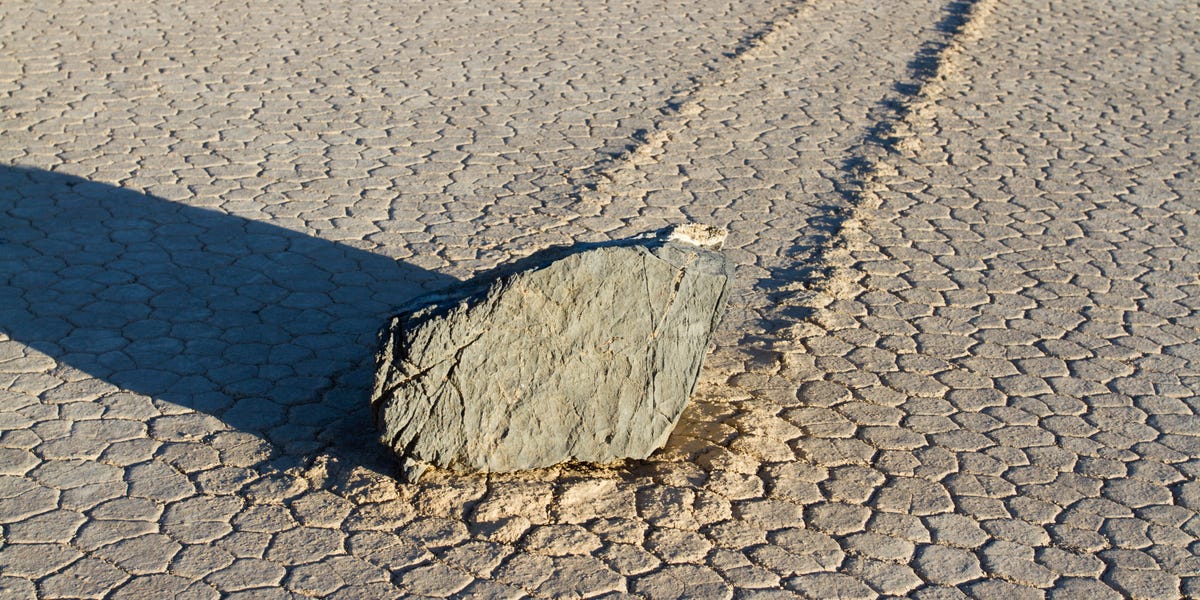
However, in the northwest corner of nearby Death Valley National Park, a different kind of race has been underway since time immemorial. In a dried lakebed located in the Cottonwood Mountains in eastern California lies Racetrack Playa. But there, you won’t find souped-up racers ready to break the sound barrier. Instead, you’ll find small boulders made of dolomite and syenite stranded on a sea of flat, dried mud. That, by itself, wouldn’t be so weird, seeing as the surrounding mountains are made of the same minerals. But these stones—some weighing as much as 700 pounds—move across the desert on their own. They even leave tracks in their wake.
For nearly a century after prospectors first glimpsed these “sailing stones” in 1915, scientists and experts had no idea how the strange rocks moved across the desert. According to the University of California Santa Barbara (USCB), early theories suggested that, in the rare times when rain filled the playa, the mud became slick enough for wind to simply push the rocks along. Another, more outlandish, theory suggested that magnetic fields somehow pulled the rocks slowly and imperceptibly along.
Finally, in 2011, Johns Hopkins University researcher Ralph Lorenz (along with experts from NASA, the University of Idaho, the Space Science Institute, and the California Polytechnic State University) decided to get to the bottom of it. Years earlier, Lorenz was setting up weather stations in Death Valley as part of a project with NASA—the area’s so inhospitable that it serves as a convenient analog for Mars—when he first spotted the “sailing stones” and decided to unravel their mystery. Speaking with Smithsonian Magazine in 2013, Lorenz said his big breakthrough was actually a kitchen table experiment.
“I took a small rock, and put it in a piece of Tupperware, and filled it with water so there was an inch of water with a bit of the rock sticking out,” Lorenz said. “I put it in the freezer, and that then gave me a slab of ice with a rock sticking out of it.”
Lorenz described sticking the rock-ice concoction in a tray of water with sand on the bottom. When he gently blew on the rock, it glided across the tray, leaving marks on the sand below.
“Basically, a slab of ice forms around a rock, and the liquid level changes so that the rock gets floated out of the mud,” he told Smithsonian Magazine. “It’s a small floating ice sheet which happens to have a keel facing down that can dig a trail in the soft mud.”
In other words, the secret of Death Valley’s sailing stones is the perfect balance of water, ice, and rock.
In 2011, Lorenz and his team published a model detailing this fascinating piece of real-time geology, and in 2014, he provided visual evidence of the rocks in motion for the first time.
“Science sometimes has an element of luck,” Richard Norris, lead author of the 2014 study, said at the time. “We expected to wait five or ten years without anything moving, but only two years into the project, we just happened to be there at the right time to see it happen in person.”…Read more by Darren Orf