





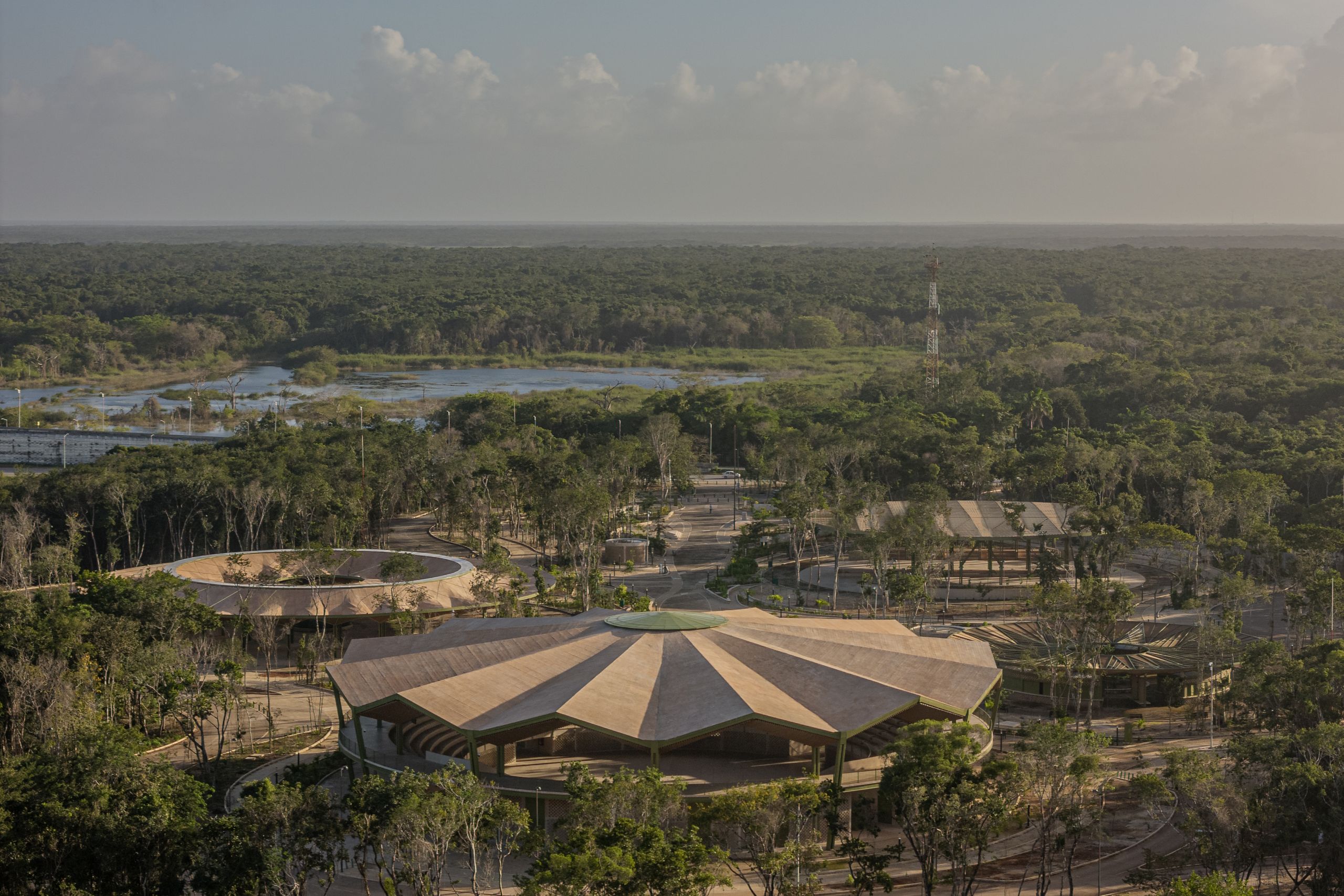
Dynamic and rich in heritage, nature and contemporary culture, Mexico is a thriving playground for architectural experimentation. A strong tradition of globally prominent architecture practice, much of it socially engaged – think Frida Escobedo, Gabriella Carillo, Tatiana Bilbao or Fernanda Canales – has paved the way for practitioners ready to challenge the status quo. It is not a country without problems. Socioeconomic divides, security concerns and the kinds of environmental worries shared across the globe mean there’s a lot of work to be done by the country’s new generation of architects, too.
Nine Mexican architecture studios shaking up the scene
Luckily, Mexico’s flourishing emerging architecture studios are ready for business – and even if they don’t have all the answers just yet, they come armed with a strong desire for change, trial and testing in order to produce designs that will help move the needle on all counts, in their home country and beyond.
Rolando Rodríguez-Leal and Natalia Wrzask met in in 2006. Before establishing their own practice, Aidia Studio, in 2018, the Mexican-Polish couple worked at leading international firms, including Architects and Ateliers Jean Nouvel. Now, their designs aim to blend environmental considerations with form-finding exploration, balancing ambitious, eye-catching looks with concerns and a contextual take.
Founded in 2016, Palma is headed up by Ilse Cárdenas, Regina de Hoyos and Diego Escamilla, all graduates of the School of Architecture at the Universidad Nacional Autónoma de México (UNAM). Now with bases in and Sayulita, the trio work fluidly across scales and typologies, leading a team of seven while placing agility, experimentation and a sense of restless curiosity at the core of their approach.
In 2023, the directors of Arca Tierra, an organic farm in southern , approached Sana Frini and Jachen Schleich to design a space for their new restaurant Baldío that would reflect their zero-waste ethos. Frini and Schleich were thrilled. Over the previous three years, the architects had built their practice, Locus, around what Frini calls ‘eco-localism, which isn’t “ecological”, exactly, but comes from the ecosystem you’re in’ – environmental, but also material, creative and social.
As a child growing up in , Carlos Matos often spent time at the home of his grandfather, architect Ernesto Gómez Gallardo, in the affluent district of San Jerónimo. Built in the late 1970s, the brutalist Casa Möbius was ‘distanced from the idea of comfort, slightly dysfunctional’, recalls Matos. ‘Even the bathrooms were triangular. It was absurd.’ Despite its peculiar layout, the house also offered ‘spaces for every kind of interaction’. It was a habitable provocation, prodding at what Matos calls ‘the boundaries between architecture and sculpture.’ That boundary – blurred, possibly obsolete – has been central to his practice ever since.
Alessandra de Mitri started out studying architecture at the ’s Oxford Brookes University, but felt disheartened by the programme. She sought a more experiential approach, one that treated space not merely as structure but as a medium for lived experience. This led her to ’s Mendrisio Academy, where the curriculum focused on phenomenology, emotional resonance and sensory perception. Here she met Roberto Rodríguez, an architect from who had arrived at Mendrisio driven by a curiosity that mirrored her own.
Current members of Office of Urban Resilience, Elena Tudela, Victor Rico and Adriana Chávez, were working toward their master’s degrees at the Harvard Graduate School of Design when they heard about an open call from the Rockefeller Foundation for a project called 100 Resilient Cities. Raised in , the trio immediately thought of their geologically unstable hometown as a perfect candidate for funding a comprehensive resiliency strategy.
‘Atmosphere is as important as function,’ declare the RA! team. It’s a statement that permeates the studio’s operation, and it is central to its ethos that recognises emotion to be as strong a power in architecture as technical performance. Co-founders Cristóbal Ramírez de Aguilar, Pedro Ramírez de Aguilar and Santiago Sierra explain: ‘We understand architecture as a sequence of spaces not as a static object, but as a transition.’
Emerging in the Mexican city of Guadalajara around 1927 and strongly active until 1936, the Escuela Tapatía de Arquitectura was a movement that sought to forge a distinctly regional vein of , favouring local materials and artisanal craft in response to the era’s preoccupation with industrial novelty and stylistic experimentation. Nearly a century later, local architects Laura Barba and Luis Aurelio Piña of Barbapiña Arquitectos cite that vision as a guiding principle of their practice. However, their devotion manifests in a contemporary interpretation of the ethos, adapted across diverse sites and programmes.
‘At the core of our practice lies the idea that architecture should reveal, not impose,’ say the Pérez Palacios Arquitectos Asociados (PPAA) team. ‘Each project begins with an understanding of its site, material, cultural and climatic conditions, and translates these into spatial experiences that feel inevitable and alive.’ Pérez Palacios Arquitectos Asociados (PPAA) is still a relatively young practice, yet it has grown in leaps and bounds since its foundation in 2018 by Pablo Pérez Palacios. A philosophy centred on sensitivity, balance and a deeply contextual understanding of each scheme sits at the heart of the studio’s work. This is also reflected in its make-up as the practice now operates as a collective of some 15 collaborators with key members including head of strategy Emilio Calvo Garza and interior designer Michelle Katrib.…Read more by Ana Karina Zatarain, Michael Snyder, Ellie Stathaki