





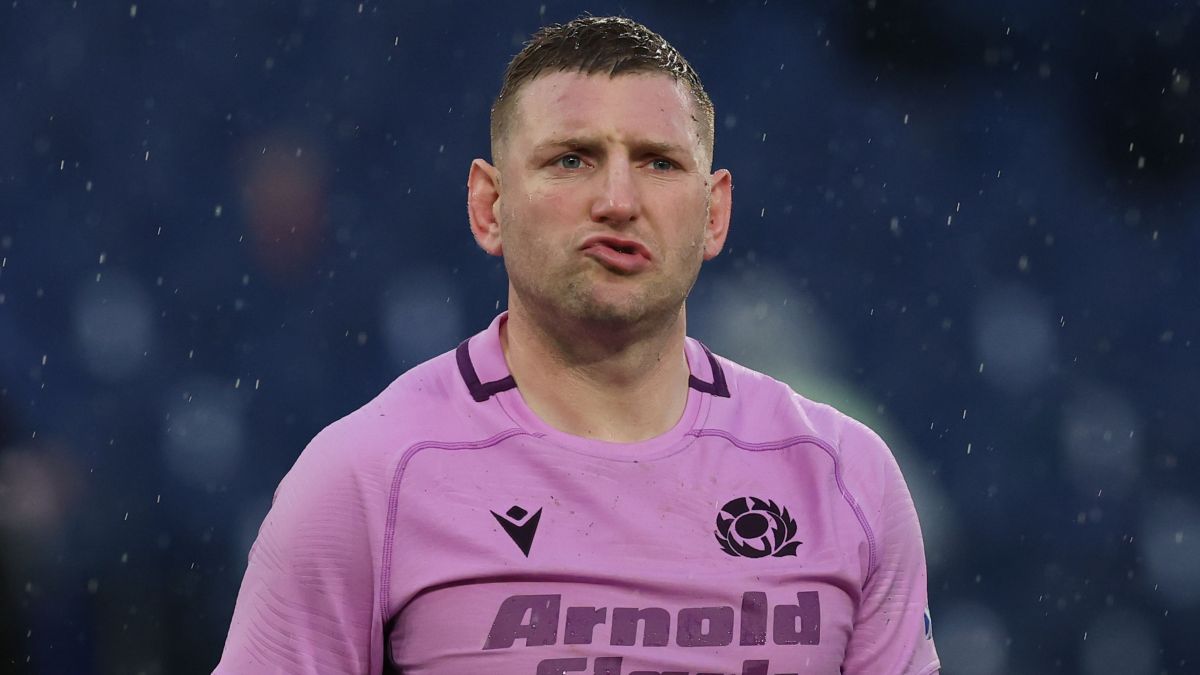
It is perhaps a reflection of just how dreadful a day that was in Rome that we are scrabbling around for positives after one week of the Six Nations.
Nonetheless, I will not be alone in welcoming the dry, sunny weather forecast for Murrayfield on Saturday with barely a breath of wind. Quite the contrast to the deluge at the Stadio Olimpico, where players diving in to score at the corner were in danger of aquaplaning all the way out of the ground.
The prospect of a dry pitch and ball will hopefully encourage the kind of game we saw last year, when both sides looked for width at every opportunity and a great ding-dong battle ensued. England won it 16-15, even though Scotland won the try count 3-1. In their victories in 2023 and 2024 (which made it four successive Calcutta Cups), Gregor Townsend’s team outscored England by a cumulative seven tries to five.
Key to each of those successes was one Finn Russell, who has been at the heart of everything good about Scotland in the fixture all the way back to that pass to Huw Jones, which helped to set up a try for Sean Maitland in the victory eight years ago.
Thirteen months later, at Twickenham, the fly half instigated that still scarcely credible turnaround from being 31-0 down by abandoning the kick-dominated approach that had served the team so badly in the first half-hour.
Scotland were — and are — at their best when Russell is playing what he sees in front of him, and not by rote. The quality and consistency of his kicking game have improved out of sight in recent years, but while it is almost impossible to judge any half back’s kicking game in those conditions, the Italian pair of Alessandro Fusco and Paolo Garbisi brought a much more accurate and, crucially, varied approach.
Of course, it is hard to put the ball through the hands when it resembles a bar of soap, but the biggest attacking threats in the Scotland team went underserved in the opening 20 minutes, when the ball was dry and the possibility to play remained. The Italian defence — rock solid as it was — did not have to do much second-guessing.
“Predictable” is the last way you would expect to describe an attack with Russell at the helm, but that is exactly what Scotland were in Rome, and I do not see them winning an arm-wrestle against England. Townsend’s team must go back to what we all know and love about them: ambition, dynamism, variety and intent.
Does that mean reverting to some of the personnel who have been such crucial wingmen for Russell in this fixture? I do not think it is fair to make any sort of sweeping judgment on back-three players in those conditions, but I do wonder if Blair Kinghorn may replace Tom Jordan to give Scotland a longer kicking option (to be clear, I am not saying the aerial route has to disappear from their game altogether), and I also love the way the Toulouse man comes into the line to offer himself as a first or second receiver.
Kyle Steyn deserves to start again on one wing, and though Duhan van der Merwe has such an extraordinary record against England, I would expect his exile to continue. On his day, he is one of the most dangerous ball-in-hand wingers in world rugby, but his form does not justify selection ahead of Steyn, Jamie Dobie or Darcy Graham.
A huge consideration will be the inevitability of George Ford peppering the Scottish back three. Backfield coverage is going to be put under the microscope like never before, and you would have to add that to the long list of things that failed against Italy.
So much of Scotland’s struggle to get anything going in attack was due to not only the weather but their set piece too. As is always the case when a lineout disintegrates, fingers have been pointed at the hooker. While Ewan Ashman had a number of errant throws, poor calls, poor lifts, Italian “double banking” by throwing two pods up all contributed to a miserable day at the office for the Scotland pack.
When a hooker is dummy throwing at the very end, with the game still in the balance, it is the equivalent to the yips in golf, whereby mental suffering has overtaken the physical doing of the act. The lineout has lost its rhythm, and more importantly its confidence. We have not seen that from a Scotland pack for a number of years, and the inability to fix the problem on the hoof will hurt the players almost as much as the inaccuracy itself.
England will be thinking, let’s throw two pods in the air, and double down on the psychological warfare for hookers, jumpers and callers. That said, for Scotland — who have had an excellent lineout in the very recent past — this should be an easier fix than the scrum.
Italy’s scrum gave South Africa their sternest test of the autumn, but even allowing for what they were facing, the Scots were shown up in this phase and, again, England will smell blood. It may even feed into the perception of Nika Amashukeli, the referee, who will also have seen Scotland’s scrum being dismantled by Simone Ferrari and co. Yes, it is hard to get purchase with your studs in those conditions, but Italy seemed to manage.
Ashman has been one of Scotland’s best players in recent times. He was outstanding in their autumn campaign and has been a shining light for Edinburgh during a difficult season. He remains Scotland’s leading hooker by a distance. I would keep the same front five, and when it comes to the loose forwards, I would be asking what your back row is meant to do when you can’t win a scrum or lineout. To this end, I would not be against bringing back Jamie Ritchie as a third lineout jumper. I was really surprised not to see him or Kinghorn on the bench in Rome.
Even if Scotland have convinced themselves to write off what happened on Saturday as being purely because of the conditions, I have no doubt we will see a big reaction this weekend. We have had enough disappointment over the years to get good at the “response” piece. That is not really the problem. The problem is delivering when it is expected.
If Scotland do win, it would give weight to that maddening cliché about them only getting up for England, but it would also give them a chance of salvaging something substantial from this campaign. Going to Cardiff in round three with one win would be very different from heading to the Principality Stadium off the back of two defeats, particularly with France and Ireland still to come.
I always felt that this game would be pivotal for both teams, and they could not be approaching it from more polarised positions. One has a heap of pressure on the coach, and question marks over the players and their ability to deliver under pressure. The other faced the same doubts a year ago, but have turned the corner. Whether they are taking the ball to the line, playing out from the back, opting for a kicking game, short game or power game — at the moment for England, it sticks more often than not.
From the starting point of Rome, it looks the toughest of asks. But if Scotland show more of themselves, I’m convinced they will look a whole lot better. As ever, a big chunk of their hopes will rest on Russell.…Read more by John Barclay