





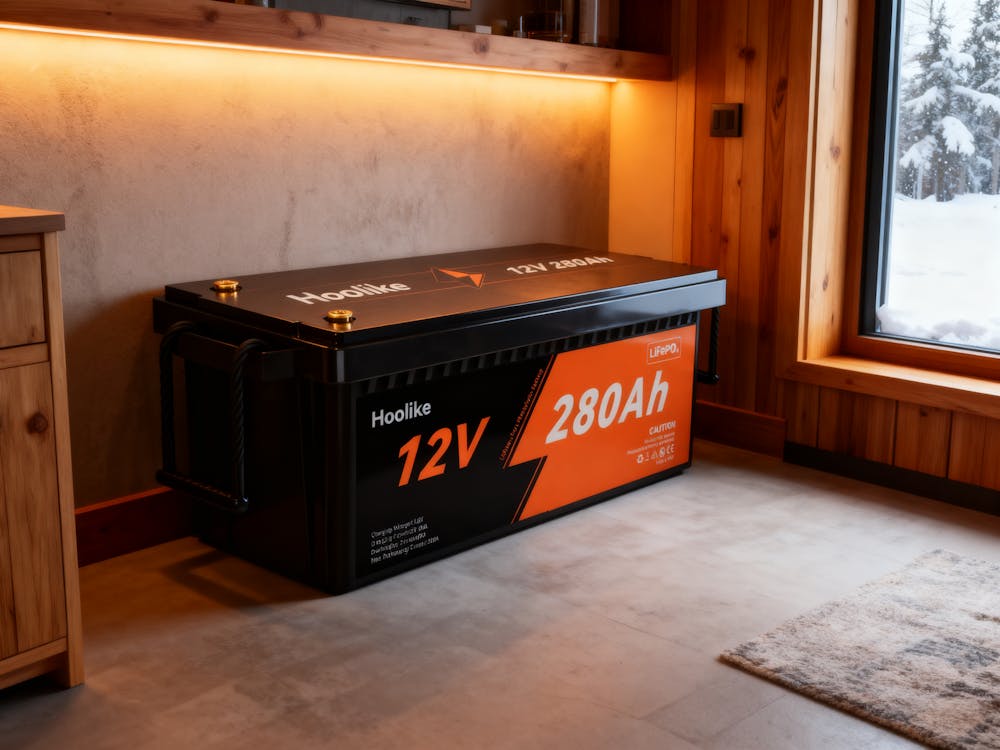
As the global transition toward decentralized renewable storage solutions accelerates, Lithium Iron Phosphate (LiFePO4) has emerged as the dominant chemistry for stationary applications. Its intrinsic safety and chemical stability make it the primary candidate for high-cycle environments. However, to maintain grid-level reliability, stakeholders must address the inherent engineering constraints of the chemistry.
This professional audit evaluates the primary lithium iron phosphate battery disadvantages and examines the mitigation strategies employed by Hoolike to optimize asset performance in diverse climates.
Compared to NCM (Nickel Cobalt Manganese) alternatives, LiFePO4 exhibits a lower specific energy density (typically 150-170 Wh/kg). In a high-capacity 280ah lifepo4 configuration, this results in a larger physical footprint.
The Utility Perspective: For stationary Energy Storage Systems (ESS), volumetric density is secondary to thermal runaway mitigation. The P-O bond in the LiFePO4 crystal is significantly stronger than the N-O bond in NCM, virtually eliminating the risk of oxygen release during internal shorts. For facility managers, the “weight penalty” is a justified trade-off for a system that requires minimal fire suppression infrastructure.
The most critical operational barrier in Northern European and North American deployments is the sub-zero charging threshold. Charging a LiFePO4 cell below 0°C (32°F) forces lithium ions to plate onto the anode surface rather than intercalating into the graphite layers, leading to irreversible capacity degradation and potential dendrite growth.
A common friction point in procurement is the lifepo4 battery price comparison against legacy Lead-Acid or lower-grade Lithium-Ion. While the initial CapEx is higher, the TCO (Total Cost of Ownership) tells a different story.
With a cycle life exceeding 6,000 discharges at 90% DoD, a Hoolike battery delivers energy at a lower cost-per-kWh than Lead-Acid, which typically fails after 500-800 cycles. For infrastructure investors, LFP represents a CAPEX-heavy but OPEX-light strategy.
LiFePO4’s voltage curve is notoriously flat, making voltage-based telemetry unreliable for grid balancing. To solve this, Hoolike employs high-precision Coulomb Counting—integrating current over time to provide an accurate SoC (Q =∫I dt). This allows for tighter integration with smart grids and more efficient peak-shaving operations.
While lithium iron phosphate battery disadvantages exist, they are no longer operational risks. Through intelligent BMS design and active thermal management, LFP has proven itself as the most resilient foundation for modern energy independence.
For detailed white papers and technical specifications, visit the Hoolike Engineering Portal.…Read more by Berry Li