





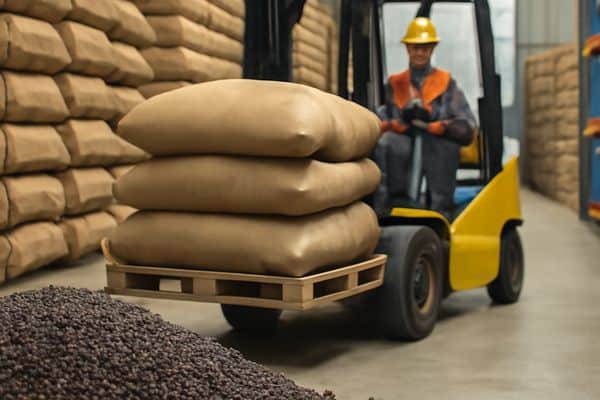
The global black pepper market is navigating a period of uncertainty as geopolitical tensions, particularly those linked to the Iran conflict, have disrupted commercial operations and logistics in major sourcing and trading regions. This disruption has notably impacted India, the world’s leading producer and exporter, where slowed arrivals and selective domestic demand are evident. Farmers in key regions—especially Kerala and Karnataka—are facing mounting challenges, with declining volumes of the new crop reaching wholesale markets. As a result, trading has become subdued, and volatility is heightened as stakeholders closely monitor both local and international developments.
Nonetheless, despite reduced transaction volumes, the market has exhibited remarkable resilience: export prices have edged upward, signaling underlying strength in global demand even as overall export volumes dip. Export prices remain historically firm, and the next several weeks will hinge on whether trade flows can stabilize, supply chains normalize, and whether selective buying can sustain support for a broader recovery in trading activity. In this context, today’s analysis explores the intersection of geopolitics, supply chain bottlenecks, shifting demand, and price trends, revealing an environment defined by cautious stability but also latent bullish potential should disruption abate.
Exclusive Offers on CMBrokerPepper powderblackFOB 9.00 €/kg(from IN)Get Your Delivery CostPepperwhite wholeFOB 7.30 €/kg(from IN)Get Your Delivery CostPeppergreen dehydratedFOB 8.75 €/kg(from LK)Get Your Delivery Cost
Prices
Product
Origin
Location
Type
Organic
Price (EUR/kg)
Prev. Price
Update Date
Market Sentiment
Pepper powder
IN
New Delhi
Black
Yes
9.00
9.00
2026-03-07
Stable
Pepper (whole)
IN
New Delhi
White
Yes
7.30
7.25
2026-03-07
Firm
Pepper (green, dehydrated)
LK
Sri Jayawardenepura Kotte
Green
Yes
8.75
8.70
2026-03-07
Steady
Pepper (black, 500 g/l, whole)
IN
New Delhi
Black
Yes
8.32
8.28
2026-03-07
Steady
Pepper (black, 600 g/l, clean)
VN
Hanoi
Black
No
6.65
6.60
2026-03-07
Stable
Pepper (black, 550 g/l, faq)
VN
Hanoi
Black
No
6.25
6.20
2026-03-07
Steady
Pepper (black, 550 g/l, clean)
VN
Hanoi
Black
No
6.32
6.27
2026-03-07
Stable
Pepper (black, 500 g/l, clean)
IN
New Delhi
Black
No
5.85
5.80
2026-03-07
Steady
In Indian spice markets (USD reference): recent black pepper prices range between USD 8.9 and 9.0 per kg, slightly down from previous peaks of around USD 9.1/kg, reflecting a moderate adjustment tied more to logistics than underlying supply/demand.
Supply & Demand
India’s main black pepper producing states (Kerala, Karnataka) saw rising arrivals in prior months, but conflict-related disruptions have slowed inflows recently.
Farmers face difficulties in selling as logistical hurdles persist, directly leading to reduced marketable supplies and quieter wholesale markets.
Despite reduced new crop arrivals, domestic demand is providing a floor; buyers remain active but are purchasing more selectively, cautious of ongoing instability.
In 2025–26 (Apr–Nov), Indian exports dropped to 14,477 tonnes (vs. 15,321 tonnes y/y), a mild decrease, yet the average export price grew to USD 8.5/kg—evidence of global price support due to robust international interest, especially for quality product.
Fundamentals
Price softness is directly attributed to temporary market and logistical disruptions, not a major swing in fundamentals—once trade stabilizes, activity is anticipated to recover.
With export prices rising year-over-year even as volumes soften, premium and quality differentiation remain strong drivers, buffering declines in traded tonnage.
Major exporters—India, Vietnam, Sri Lanka—remain the world’s engines of supply; India’s higher export prices support the broader global price structure.
Weather Outlook
Recent weather in southern India (Kerala, Karnataka) has been largely favorable, supporting crop prospects, but shifting monsoon patterns bear watching in the months ahead.
No major weather risks reported at present; supply-side issues remain largely logistical and geopolitical.
Global Production & Stock Overview
India: Major producer/exporter; slow exports but rising values; moderate crop inflows due to trade.
Vietnam: Steady supply to global markets with FOB prices for black pepper around EUR 6.25–6.75/kg.
Sri Lanka: Niche player with solid organic offerings; green dehydrated pepper FOB EUR 8.75/kg.
Brazil: Cheapest origin; black pepper FOB price as low as EUR 4.13/kg (conventional).
Trading Outlook & Recommendations
Short-term: Expect continued market caution with selective buying—watch for logistics normalization around India; price floor likely maintained by resilient demand and tight farmer sales.
Medium-term: Geopolitical tensions will determine direction; a return to normalcy in trade routes and market flows could trigger a recovery in trading activity and potentially firmer prices.
For Buyers: Consider accumulating on dips while monitoring for supply resumption; quality origin (India/Sri Lanka) offers premium potential.
For Sellers: Limited new arrivals suggest holding stock for stronger future pricing could be advantageous if trade disruptions persist but do not worsen.
3-Day Price Forecast (FOB, Key Origins)
Origin
Type
Current (EUR/kg)
3-Day Forecast
Trend
India
Black, organic
9.00
8.90-9.05
Stable
India
White, organic
7.30
7.25-7.35
Stable
Sri Lanka
Green, organic
8.75
8.70-8.80
Stable
The post Pepper Market: Cautious Stability Amid Disrupted Trade and Selective Demand appeared first on Commodity Board Europe is an independent commodity market intelligence platform providing global production data, price insights and market analysis for agricultural and food commodities..
Related posts:
Coriander Prices Eye Recovery: From Oversupply to Cautious Optimism
Pepper Market Holds Firm After Holiday Slowdown: Prices, Analysis & Outlook
Cumin Faces Output Uncertainty: Weather, War, and Trade Pressures Shape a Volatile Market…Read more by Michael