





You have been granted access, use your keyboard to continue reading.
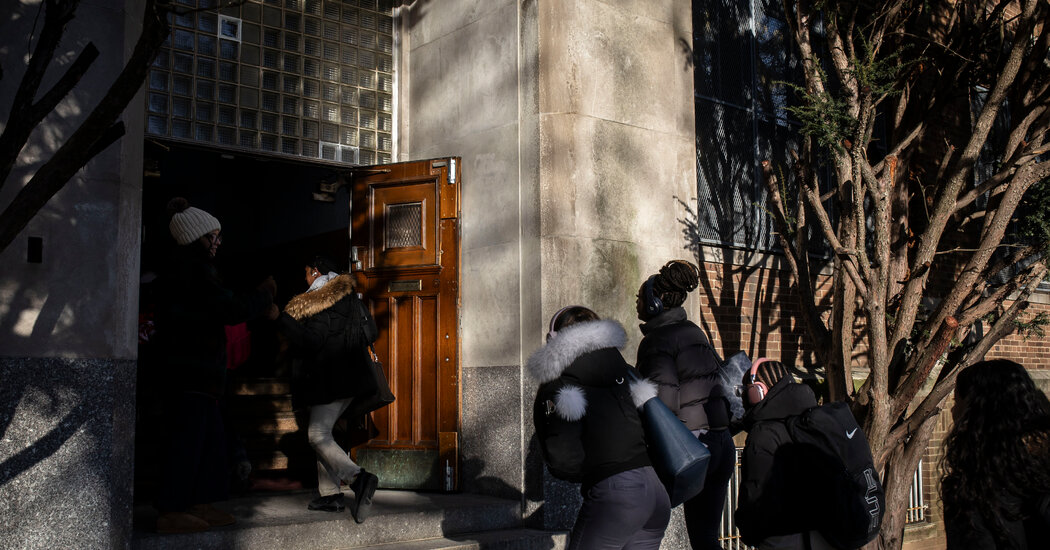
For Claudia O’Brien and her son Chase, 16, Cristo Rey Brooklyn High School in East Flatbush, a working- and middle-class immigrant neighborhood, provided a lifeline.
Leaders and parents worry that a widening economic divide amid the current affordability crisis could amplify the role that money plays in access to a robust education in New York.
As Income Gap Grows, So Do Fears Over Access to a Quality Education
Claudia O’Brien struggled to find the right school for her bright son. New York City, with the biggest education system in the United States, seemed to offer a world of choices. But her neighborhood public schools were “not up to par,” she said. Her son landed on waiting lists at some of the more desirable public options. And as a single, middle-class mother, Ms. O’Brien felt private school was beyond her reach. Ms. O’Brien understood that education can be a ticket to a better life. She had been a first-generation college student whose father, a Trinidadian immigrant, stopped attending school at age 12 to work in the cane fields. “You’ve got to be so careful where you send your kid to school,” Ms. O’Brien said. “I felt like I was failed.” Her experience reflects the high-pressure calculations confronting hundreds of thousands of families across New York as they try to decide where to enroll their children.
In Ms. O’Brien’s case, her family’s saving grace was a Catholic education at schools managing to fight off those headwinds, including Cristo Rey Brooklyn High School in East Flatbush, a working- and middle-class immigrant neighborhood. Her son, Chase, who is 16, gained access to advanced classes, after-school SAT tutoring and in-depth college guidance — which might otherwise have cost tens of thousands of dollars — for a feasible price, about $1,700 a year. “I feel grateful because it’s all affordable,” she said. The school keeps costs down for families through philanthropy and corporate partnerships: All students work once a week at law firms, health care companies and other organizations, which pay for their labor. But school leaders say that it’s harder than ever to maintain reasonable costs.
The risks for the future are clear. The crushing costs of living are often the top factor when parents choose whether to remain in New York City. But access to a quality education is often at the top of their minds, too, surveys show. One recent report on “attractive” cities put it simply: “Schools are the most powerful tools cities have to attract and retain the next generation.” Sean Reardon, a professor of poverty and inequality in education at Stanford University, said that rising income inequality could worsen gaps in student outcomes. More families see education as a scarce private good to compete for — and when that’s the case, “the people with more resources have lots more ways to try to get access.” This threatens to undermine the promise of education as an engine of economic mobility, experts say. Mr. Reardon said that cities such as New York should work to “reframe the way people think of education, to be as more of a collective good,” and get residents “excited about a good public school system — for everyone.”
Today, classrooms a mile away from one another can feel worlds apart. And money stands to play a growing role, even in public education. When public schools have shortfalls, parent associations sometimes step in — a well-intentioned practice that can deepen divides. For its biggest fund-raiser, P.S. 6 Lillie D. Blake on the Upper East Side recommends that families donate $1,700 per enrolled child, helping to pay to have assistant teachers in every classroom, third-grade African dance classes and new music and gym equipment. Across the city, more than 125 parent associations reported bringing in more than $100,000 last year; at hundreds of others, not even $1,000 will be raised. It illustrates why parents regard choices about where to send their children as make or break.
“Some families win, and some families can end up losing out,” Robin Aronow, the founder of a school admissions consulting firm, said. “It’s stressful for parents. It’s certainly stressful for the kids. “You put the financial part on top of it and it’s a really unpleasant experience.” In recent years, some middle-class parents have begun to consider charter schools, which are publicly funded, and traditionally enroll poorer families. Prospect Schools, a nearly two-decade-old network in Brooklyn, enrolls students from across income lines. Tresha Ward, the chief executive, said that in a city in which more families can “purchase access” to prime school experiences — niche clubs, travel camps, advanced math, immersion trips — it is crucial to open doors. The network offers the rigorous International Baccalaureate program to everyone, and covers costs for the exams that students take to earn the I.B. diploma, which could otherwise run parents more than $700.
Families who might not have hesitated to enroll in the past are now digging into the issue of whether they will get value for their money. “We’re getting very specific questions that years ago, we wouldn’t have gotten,” Sharon Decker, an education consultant, said. “It would have been, ‘We know that school’s name. Great, we’re applying.’” That hasn’t prevented the city’s most renowned private schools from seeing a surge in demand. They’re also receiving more applications for financial aid, often driven by families who earn $250,000 and above, underscoring just how many households feel newly strained. Today, about a quarter of students at independent schools receive aid, up from roughly a fifth a decade ago. One of the most prestigious of those — the Brearley School on the Upper East Side, where tuition will be $69,600 next year — offers full tuition to all families earning $100,000 a year or less.
Still, people across the education world said that everyone seems worried about the future. Some of the city’s wealthiest families fret about the rising interest in private schools, and are eager for tuition to keep soaring to shut out their competition. For two decades, the National Association of Independent Schools has occasionally surveyed U.S. families who apply for financial aid about their emotions when paying tuition, and 2023 was the first time the No. 1 answer was “stressed” rather than “satisfied.” “That was a huge indicator for us,” Mark J. Mitchell, the organization’s vice president of access and affordability, said, adding that he often reminds families that enrolling in private school increasingly comes with a need to make sacrifices, such as cutting down on vacations or saving less for retirement. Ms. O’Brien said she feels like one of the lucky ones. But she sees how much harder it could have been. She thought about the students from other schools “walking around with a box of candy or selling cookies at the basketball game” to afford aspects of their education. Access to a quality education, Ms. O’Brien said, is too limited. “It’s just really unfortunate.”…Read more by Troy Closson