





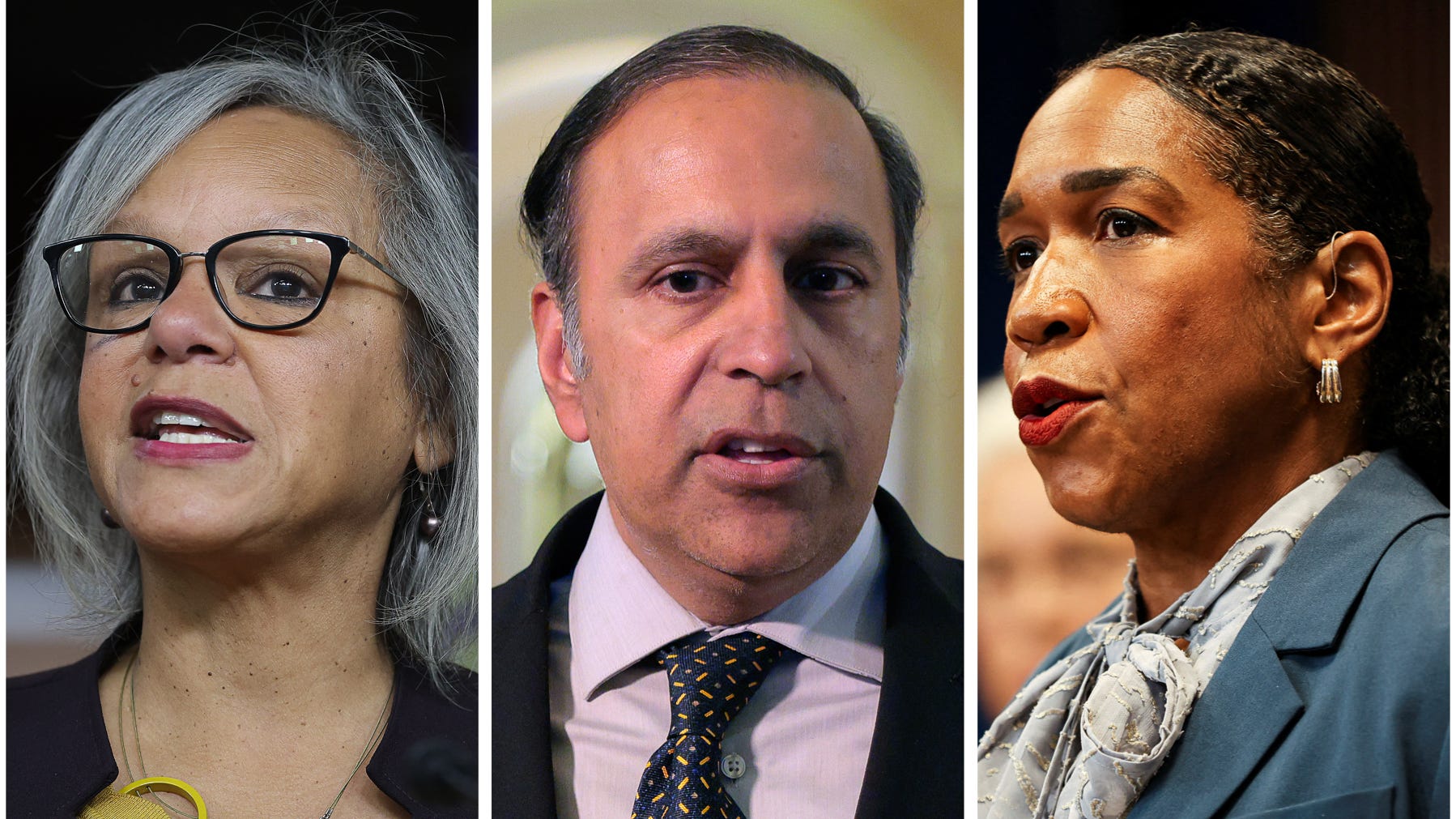
Illinois’ Democratic Senate primary will test if the party’s base wants a more confrontational approach against the GOP.
• The race pits Lt. Gov. Juliana Stratton against Rep. Raja Krishnamoorthi, with immigration policy as a key dividing issue.
Democrats clamoring for their party to get tougher on President Donald Trump will get a sense of how much of it their base wants when voters in deep-blue Illinois select a Democratic nominee to replace retiring incumbent Sen. Dick Durbin.
Unlike the recent Senate primary in Texas, where Democrats publicly weighed questions of electability, the Praire State’s March 17 primary is focused on the breadth of liberal voters’ ambition.
“I think Democrats should be doing everything possible to stop the Republican Party,” Jacob Rosenbacher, a technology executive from Chicago who voted early for Lt. Gov. Juliana Stratton, one of the top contenders, told USA TODAY.
Illinois voters must send a message to Washington, he said, in response to Trump’s aggressive use of executive authority, such as sending thousands of immigration enforcement agents and 300 National Guard troops into Chicago last year as part of “Operation Midway Blitz.”
That’s why he is supporting Stratton – a close ally to Gov. JB Pritzker, one of Trump’s fiercest adversaries – over Rep. Raja Krishnamoorthi, D-Ill., a well-funded rival who led in early polls.
Krishnamoorthi would hardly qualify as a conservative in most states: he voted against the Iran war and leans into affordability.
But Rosenbacher, 32, citing reports that Trump advisers and other conservative activists were among Krishnamoorthi’s donors, described the congressman as a “Republican in a Democrat’s suit.”
Stratton has forcefully came out in favor of abolishing the U.S. Immigration and Customs Enforcement agency and drew national attention with a profanity-laced campaign ad in February featuring several voters saying “f— Trump” directly to the camera.
That aggressive style has helped her surge in the polls, which have recently swung between both candidates.
There are at least 16 candidates running, with 10 Democrats and six Republicans vying to replace Durbin, the second-ranking Democrat in the Senate.
Illinois’ Senate race is rated a solidly blue state by forecasters in the 2026 midterms, meaning the Democratic nominee will likely prevail in the general election.
On the Republican side, former state party chair Don Tracy led with about 6% in the lone public poll, which found 84% of Illinois Republicans remained undecided two months before the election.
John Mark Hansen, a professor of political science at the University of Chicago, said the race had recently morphed into a referendum on reforming or dismantling ICE, which has seen its popularity drop dramatically nationwide following the killings of two U.S. citizens by federal agents earlier this year.
“Stratton’s political patron is our governor, so she is kind of beholden to Gov. Pritzker,” Hansen said. “She’s seen that he’s benefited, both locally and beyond, in having a more confrontational posture toward the Trump administration than many other Democrats had – and that was her posture right out of the box.”
Pritzker vehemently opposed the Trump administration when it brought its ambitious deportation campaign to Chicago, leading to scenes of federal officials deploying chemical agents on protesters and journalists outside the local immigration-enforcement facility; rappelling from Black Hawk helicopters to raid a South Side apartment building in the middle of the night; and fatally shooting Silverio Villegas-Gonzalez, a Mexican man, in the northwest suburbs who federal authorities alleged drove his car into an officer.
Hansen said smaller policy differences or questionable campaign donations could be critical given the presence of Rep. Robin Kelly, D-Ill., in the race. She is being backed by the Congressional Black Caucus, which has some political observers speculating a split among Black voters might undercut Stratton’s ascent. Both Stratton and Kelly are Black.
In an interview with USA TODAY, Krishnamoorthi, a five-term congressman born in New Delhi, India, acknowledged the race will reflect the party’s direction.
“You’ve got to hold the Trump administration accountable and fight for our principles, not necessarily engage in a lot of verbal fisticuffs with the other side and scream and shout, but rather use your leverage to protect those principles,” he said.
At a Jan. 26 debate, the three top contenders each called for ICE to be overhauled but differed on the extent. Stratton called for the agency to be “abolished” and Kelly said it ought to be “dismantled.”
Krishnamoorthi took a more moderate approach, suggesting that Trump’s leadership is the reason why the agency has gone rogue. He said it needs to be reined with specific reforms, such as banning agents from wearing masks covering their faces; requiring visible identification and body cameras; and establishing an inspector general within ICE to ensure compliances with laws and regulations.
But Stratton pounced during that discussion and called out the congressman for accepting donations from executives of Palantir, a data company that has a contract with ICE.
The lieutenant governor also slammed Krishnamoorthi for supporting a measure in the House that provided funding to the agency and voting for a resolution that among other things, “expressed gratitude” to law enforcement, including ICE agents.
“That is not the example of somebody who is going to stand up to Donald Trump and fight for all of our communities,” Stratton said during the Jan. 26 debate. “I want to abolish ICE, because this agency cannot be reformed. It doesn’t matter whose ICE it is.”
The congressman’s campaign, which released a March 12 ad highlighting Krishnamoorthi’s immigrant roots, quickly points out that CoreCivic, a company that operates immigration detention facilities, contributed more than $135,000 to the Democratic Lieutenant Governors Association, a political action committee that is supporting Stratton.
ICE has “earned the wrath” of voters, Krishnamoorthi told USA TODAY, but he added that Stratton has been dishonest in some of her attacks. He said the House resolution, for instance, was a wider measure more about denouncing antisemitism than thanking the agency.
“Look, I’m an immigrant myself. Ok? This is a personal issue to me, and so I don’t need a lecture from anyone about standing up to ICE and Border Patrol the way that I have,” he said
For more than a year, activists on the left have demanded stronger action to control ICE’s behavior, particularly from Senate Minority Leader Chuck Schumer, D-N.Y., who faced sharp criticism as party figures map out whether it’s best to focus on confronting Trump versus winning over MAGA-leaning voters.
Several Illinois Democratic voters who spoke with USA TODAY praised Senate Democrats for withholding funding for the Department of Homeland Security, over demands to reform ICE and other immigration enforcement agencies.
Christian Michel, 30, a software developer from Chicago, who is the son of Haitian immigrants, said he worries about his family “being snatched up” whenever they visit him. He said Stratton’s fiery response and position to eliminate ICE captures how many people feel about Trump’s operation, and made the difference in his decision.
“The other candidate’s position makes it seem like we’re going to continue and fall back on the status quo,” Michel said. “Getting rid of it is probably the best way to start because keeping it around would potentially keep people who are involved and who don’t have the best track record.”
If there is a wildcard in the Illinois derby for Senate then it is the role Kelly, first elected to Congress in 2013, could play in the race.
If either Kelly or Stratton were to prevail, they’d be likely to become just the sixth Black woman to ever serve in the Senate. With Democratic Sens. Angela Alsobrooks, of Maryland, and Lisa Blunt Rochester, of Delaware, there would be an all-time high of three in the upper chamber.
Krishnamoorthi, if elected, would be the second Indian American ever to serve in the Senate.
Powerful Black lawmakers in Congress, such as Rep. James Clyburn, D-S.C., have thrown their support behind Kelly. He visited Illinois this past week to host a fundraiser for her.
“If you look where the local politicians – state legislators, alderman, etc. – are lining up it kind of lines up the way you’d expect,” Hansen, the University of Chicago professor, said. “They’re sort of competitive for the same demographic and so you wouldn’t be too surprised that it’s probably Kelly who would be a spoiler for Stratton in the nomination.”
Most yardsticks of the race have the congresswoman in a distant third, such as a March 10 survey from Public Policy Polling that founded Stratton with 32%, Krishnamoorthi at 30% and Kelly holding just 13% support. Whoever wins the most votes will win the primary, regardless of whether they win an outright majority.
Some of Stratton’s supporters are quick to point out that groups aligned with Krishnamoorthi, such as Indian American Impact Fund and others connected to the cryptocurrency industry, such as a super PAC called Fairsake, have supported Kelly.
One digital spot from the Indian American Impact Fund, for instance, features former President Barack Obama, who has not endorsed in the Senate contest, praising Kelly as an “outstanding” member of Congress.
Krishnamoorthi told USA TODAY that his House colleague doesn’t need anyone to elevate her candidacy, adding he has “great respect” for Kelly.
The Kelly campaign did not respond to repeated requests for comment, but she has alluded to that issue on the campaign trail, telling voters at a March 10 event that: “A vote for Robin Kelly is a vote for Robin Kelly. Period.”
She also hasn’t spared Krishnamoorthi from criticism, saying in a March 11 post on X that in Washington her opponent is “known to be a fundraiser” while she is “known for getting s— done.”
“I do the job I was elected to do,” Kelly added. “I’ll put people over profits every day, all day, and in the Senate, too.”
Democrat Mayra Macias, an Illinois congressional candidate in the Chicago area, said the lack of diversity in the Senate matters and there could be historic turnout in those communities. But she said the tension over race hasn’t been as pronounced as it has been in other Democratic contests, such as Texas.
“We have an opportunity to send a Black woman to the U.S. Senate. That is huge, and it is frankly needed, given that the lack of diversity in the U.S. Senate,” Macias said. “But I will also say that we are past the era where being of someone’s identity is enough for voters to support you.”…Read more by Phillip M. Bailey