





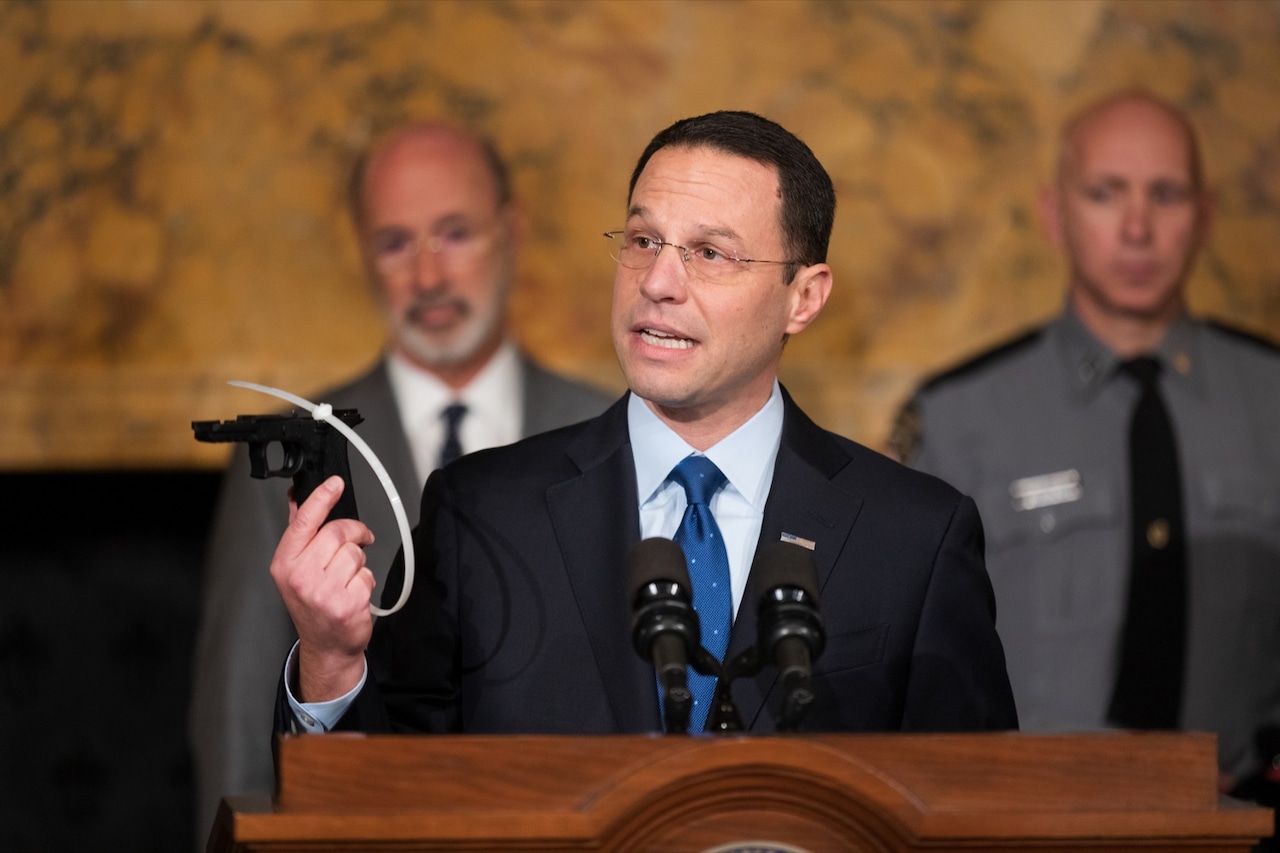
Josh Shapiro launched a gun tracing database in 2019 to improve transparency between law enforcement agencies and the public.
He wanted police to share data, to work together to track down potentially negligent gun dealers who sold large volumes of guns that were later used to commit crimes.
A year later, the former Pennsylvania attorney general who now serves as governor touted the database as a difference maker in the war against gun violence. He had stats to back him up. The number of participating police departments jumped by 67% in the program’s second year. Departments were working together to track crime guns to their source, and the public had an unprecedented level of access to that data.
Since then, the database has quietly disappeared with no public explanation as to why from the administration. A Shapiro spokesperson said it was still live in February 2023 after Shapiro had moved on to the governor’s office. But the spokesperson didn’t say when the site was taken down or why.
No news release was issued when it was removed. Both the governor’s office and attorney general’s office have refused to answer repeated questions from lehighvalleylive.com. No one from the office of Pennsylvania Inspector General Michelle Henry responded to requests for comment. She took over as attorney general when Shapiro left.
Users of the database like Philadelphia resident Micah Getz want public access to gun tracing data restored, or at least an explanation from Shapiro about what happened.
He suspects the state has been silenced by pro-gun advocacy groups and the threat of lawsuits. A 20-year-old federal law restricts public access to much of this data. The law was established protect gun shops from being sued.
“It’s crazy to me that because one industry is afraid of bad press, they can bully the government into keeping us ignorant of why crime happens,” Getz told lehighvalleylive.com.
The database allowed residents to know the county of origin for each gun used to commit a crime in Pennsylvania. And it made make data quickly available to police departments across municipal lines.
Police departments bought in. Eight times as many police departments were sharing gun tracing data than they were before the platform launched, Shapiro said in a 2020 news release when he was still attorney general. He was elected governor in 2023.
“Local police are able to identify a record number of crime guns, allowing investigators to go after the source and help prevent shootings,” Shapiro wrote in 2020.
“It’s a big step in the right direction,” agreed Montgomery County District Attorney Kevin R. Steele in the release.
Now, when you try to search the Pennsylvania Gun Tracing Analytics Platform, you’re directed to the home page of Pennsylvania Attorney General David Sunday.
That didn’t stop lehighvalleylive.com from finding the data and creating its own database showing the flow of “crime guns” across Pennsylvania. Our map uses the state’s redacted data to show the number of crime guns sold and recovered for each Pennsylvania county in 2021.
When lehighvalleylive.com started asking questions about the database last year, Shapiro’s Track + Trace news releases from 2019 and 2020 disappeared from the Web. Spokespeople for the governor’s office and attorney general’s office had no comment on the missing news releases.
The database butts up against the Tiahrt Amendment of 2003, a federal law that restricts the release of information about where “crime guns” are purchased. Police often need this information to confirm whether someone suspected of a crime can be linked to the purchase of the gun used to commit that crime.
Gun store owners, however, don’t want conclusions drawn based on the number of guns they sell that end up being recovered at crime scenes. The store owners are wary of lawsuits blaming them for escalating gun crimes based on the volume of “crime guns” they sell.
“Gun control activists seek access to this sensitive data in bogus efforts to ‘name and shame’ (gun store owners) and to blame them for crimes they did not commit.” said NRA spokesman Nick Perrine.
To lessen the likelihood of singling out vendors for flooding the market with “crime guns,” federal law restricts the U.S. Bureau of Alcohol, Tobacco, Firearms and Explosives from making a database with records of every gun sale. Paper records are the default mode of keeping gun sales records, although stores can opt in to a digital eTrace system if they choose.
Police departments can release information about traces on “crime guns,” but they are prohibited from releasing the name of the store where the gun was purchased.
Shapiro was mindful of these rules when he created the gun tracing analytics platform. The database disclosed the crime to which each gun was connected, the law enforcement agency who recovered the gun and the person who had the gun when it was recovered.
It listed the county in which each “crime gun” was purchased but not the store where each was sold.
An internal letter obtained by lehighvalleylive.com through a Pennsylvania Right-to-Know request shows Shapiro’s office checked with federal ATF officials to make sure it wasn’t breaking the law by releasing that information.
The letter from June 2022 says Shapiro’s multi-jurisdictional trace data didn’t allow for the analysis of “firearm trafficking trends and leads” and kept its data on the “macro” level, so it did not violate federal law.
The disappearance of the database coincides with the release of a Pennsylvania Crime Gun report by the nonprofit organization Brady Unlimited. Brady took a snapshot of Pennsylvania’s gun tracing database and used it to compile its own report, going a step further than Shapiro’s database.
Brady downloaded all the raw data made available on the gun tracing analytics platform on Aug. 24, 2021, according to Brady’s public report. Brady shared that data with lehighvalleylive.com. Lehighvalleylive.com used the data to create a map showing the county of origin for each of the crime guns and where each crime gun was recovered.
It’s important to note that only 117 out of Pennsylvania’s 501 police enforcement agencies opted to participate in the platform. While the database wasn’t comprehensive for the entire state, Brady was able to draw some insightful (though limited) conclusions from it.
For instance, Brady determined about 51% of the traced crime guns from the database originated in Philadelphia. Another 28% came from out of state and 22% came from unknown origins.
While the raw data didn’t disclose the names of store owners, it did have a column headed “dealer phone,” under which Brady found a list of phone numbers. Brady cross-referenced those phone numbers with the phone numbers of gun dealers listed on the Federal Firearms Licensee registry. Brady used internet searches and other means to try and track down the owners linked with phone numbers that didn’t match the federal registry.
Brady acknowledged the limitations of its methods. It wasn’t a completely comprehensive list, but Brady was able to match a significant number of the 186,000 gun traces listed in the Shapiro database to various store owners. The data shows a small number of gun dealers are responsible for a large number of “crime guns” flowing into the state.
About half of the “crime guns” traced back to in-state dealers were sold by just 1% of those dealers. Ninety percent of the total guns traced were sold by 20% of the dealers, according to Brady
Brady released its report in April 2022, calling it “the clearest picture of Pennsylvania crime guns and crime gun sources since the late 1990s/early 2000s.”
“This is the most important gun trace dataset the public has seen in decades,” Brady added.
Was Brady’s ability to crack Shapiro’s code the reason to dismantle the database?
No one would say.
Brett Hambright, the communications director for Attorney General Sunday, said gun tracing data originates from the ATF, so it’s not his place to comment on how that data is maintained or distributed by his office.
Asked whether Sunday would consider re-posting Shapiro’s data from 2020, Hambright said, “I do not have anything definitive to offer as far as whether this data will be revisited and positioned on our public website.”
A spokeswoman for now-Governor Shapiro directed lehighvalleylive.com to statistical data on gun trafficking made available by state police but declined to comment on Shapiro’s old data or what happened to the database.
Lehighvalleylive.com filed the right-to-know request in August to determine whether the attorney general’s office shut down the website in response to threats of litigation. Five months later, the response sheds little light on what happened.
Lehighvalleylive.com asked for any letters, emails or correspondence between 2020 and 2023 concerning the subject matter of the Pennsylvania Gun Tracing Analytics Platform. The answer was delayed by a cyber-attack against the attorney general’s office. The attack interrupted the office’s email service and made it difficult for the attorney general’s office to retrieve some digital records.
An initial estimate of 14,000 records was whittled down to 3,200. The attorney general’s office took a closer look and eliminated emails and letters that might breach attorney-client privilege or were sent as part of deliberations toward a policy-making decision.
Lehighvalleylive.com took possession of those records Feb. 24. Among them were requests for information about the gun tracing database from three news reporters, two students, a data scientist, a township police lieutenant and Micah Getz.
Getz wanted gun tracing data as part of a volunteer effort with his church group. He wanted to correlate it with Philadelphia’s unemployment rate and school closure information to show how gun crime is concentrated in neighborhoods with high unemployment rate.
“When you live and work in a poor urban community and you know people who have been shot or murdered with guns, it’s nice to dream that we could close pathways to cheap illegal gun ownership and that there’d be less violence during the next cyclical wave of unemployment,” he said.
Getz sent an email to the state attorney general’s office with questions about data in the gun tracing analytics platform in August 2022. Nobody replied to him.
Members of the attorney general staff replied internally to each other concerning Getz’s email. We don’t know what they said to each other because the email chain released to lehighvalleylive.com only discloses Getz’s initial question. The rest of it is redacted.
More than three years after Getz sent his inquiry, Getz was dismayed to see that the website was taken down. He believes the public has a right to that data.
“It’s frustrating that the data the state chooses to provide will push us to a more punitive policy next time there’s cyclical unemployment and rising murder rates,” Getz said.
CeaseFire PA spokesman Adam Garber said his organization wants the attorney general’s office to restore the gun tracing database. His office asked former attorney general Michelle Henry’s office about bringing back the Pennsylvania Gun Tracing Analytics Platform. They haven’t approached Sunday, though.
“We continue to believe that providing information so that policymakers and the public can understand where crime, guns are coming from and the sources of them is not only critical to understanding how violence happens, but also to preventing it and identifying solutions,” Garber said.
If you’re selling guns ethically, then there’s no reason to hide your records, according to Josh Scharff, Brady’s general counsel and senior director of programs.
While the Tiahrt Amendment protects gun dealers from what they call frivolous lawsuits, it also lengthens the period to perform a legal gun trace, according to organizations like Brady.
Without a central ATF gun registration database, the agency holds voluminous non-searchable records of gun sales. With no searchable database, it takes seven to 10 days for ATF to complete a routine gun trace, according to ATF Philadelphia spokesman Ben Benson.
If a trace is urgently needed, though, that request can be expedited, he said.
“Urgent trace requests, of which we receive on average 20 to 40 per day, have an internal goal of being completed within 24 hours, but we have a high success rate of getting them done much faster,” Benson said.
Efforts to repeal Tiahrt have failed since 2003. The most recent bill was put forward last year by U.S. Rep. Madeleine Dean, a Democrat from Montgomery County.
Brady United continues to call on state and federal lawmakers to use the gun tracing data as material to better regulate gun dealers. The organization calls on gun dealers to adopt a Brady’s Gun Dealer Code of Conduct to try and limit the number of “crime guns” flooding the state.
Garber and Scharff insist on the full release of ATF tracing data, and failing that, a revisiting of the Pennsylvania database. Gun trafficking is rarely executed by a lone perpetrator on a lone buy. It’s often a group effort that requires a comprehensive approach from law enforcement, Garber said.
“Tracing allows law enforcement to quickly identify those gun trafficking rings so that they can hold them to account and shut them down,” Garber said.
Without that data, organizations like Brady can only guess where the state’s crime guns originate.
“Let the data guide the policy,” Scharff said. “We shouldn’t be scared of that. Let it be public and let’s figure out what the best policies are from the best information.”…Read more by Rudy Miller | For lehighvalleylive.com