





JIJIGA, Ethiopia — The land here used to speak.
At dawn in Kebribeyah district, Somali Regional State, eastern Ethiopia, the plains stretch wide beneath a pale sky, with dusty shades of brown and yellow broken by thorny acacia trees and the slow movement of livestock across the horizon.
For generations, pastoralists learned to read the landscape. The arrival of seasonal winds, the timing of the rains, and the alignment of stars all carried meaning.
Mohamoud Sulub, a 50-year-old livestock herder, grew up relying on these signs in Guuyow village. They told him when to move his herd and when to stay. He knew his neighbors would, in hard times, understand them, too — and help when needed.
That knowledge is now failing him. This year, Mohamoud says, there is simply nowhere to go. “The land is all drought,” he tells Mongabay.
The father of six has spent his entire life herding animals across this arid landscape, as his father did before him. Today he keeps 40 goats and sheep, five cows and six camels.
“When the rains are good, the land is fine and there is no need to move,” he says. “But during drought, we migrate.”
For generations, pastoralists like Mohamoud relied on mobility and strong social bonds to survive the harsh climate of eastern Ethiopia. When pasture dried up in one area, families moved their livestock to greener grazing grounds. Communities supported each other during difficult times: sharing water, forage and animals with those who had lost their herds.
But across Kebribeyah district, that social fabric is beginning to fray.
In a region where survival has long depended on shared resources, repeated droughts and unpredictable rainfall linked to climate change are pushing communities to their limits. The Somali clan system, central to social life, is built on rules of mutual support. But as drought stretches on, entire communities are affected at once, leaving fewer households able to help others. What once functioned as a system of collective survival is now under strain.
The stars are now lying
Historically, Somali pastoralists survived drought through strong social networks. These Indigenous climate adaptations were built on an intricate system of mutual aid.
One of the most important systems is known as Gergar, a form of social insurance in which families who lose livestock receive animals from relatives and neighbors to help rebuild their herds.
“When people used to lose livestock, others would help them,” says Mohamed Abdi, a lifelong pastoralism advocate and director at Jijiga University’s Institute of Pastoral and Agro-Pastoral Development Studies. “We would move to relatives or sub clan areas, and they shared water and pasture with us.”
Today those resources are increasingly scarce. The same study, through a survey of 191 households, found that traditional social safety nets are weakening as many households struggle to maintain their own herds.
Abdi says the Somali region’s well-known clan system, along with Indigenous adaptation strategies, evolved as a set of social rules built around cooperation.
“The fact that these Indigenous strategies have been tested to their limits and are now disappearing should not be a surprise,” he tells Mongabay. “When everyone is suffering, there is little left to share.”
Kebribeyah lies in one of Ethiopia’s driest regions, where annual rainfall averages just 400 to 500 millimeters (15.7 to 19.7 inches) and temperatures regularly climb above 23° Celsius (73.4° Fahrenheit). The area normally receives rain during two short seasons known as Gu and Deyr, which replenish pasture and water sources for livestock.
But pastoralists say those seasons are no longer reliable.
“The climate has become progressively hotter and drier,” says Nuur Muhammad, another lifelong pastoralist in the area. “Rainfall is no longer predictable, and droughts are happening more often.”
Scientific data confirms their observations. A 2022 study by researchers from Addis Ababa University and Hawassa University, both in Ethiopia, alongside international partners analyzed nearly four decades of meteorological records from Kebribeyah. The results show the climate becoming increasingly unstable.
Rainfall variability in the district exceeds 30%, a threshold scientists use to classify rainfall patterns as highly erratic. In practical terms, it means that precipitation fluctuates so sharply from year to year that long-term planning based on past experience becomes increasingly unreliable.
Xidaar, the ancient weather forecasting system based on the alignment of stars, the color of the sky and the behavior of animals, has also lost its reliability. Elders say the rain no longer follows the patterns the stars predict, making traditional forecasts increasingly uncertain.
The study also found that long-term annual rainfall has not declined dramatically. Instead, what has changed is the rhythm of rainfall. Rain is increasingly concentrated into short periods, while dry spells grow longer.
For pastoral systems that depend on steady moisture to regenerate pasture and sustain water sources, researchers say, this shift can be devastating. Grazing lands require consistent rainfall spread over time, not brief bursts followed by prolonged drought.
Communal grazing systems once played a central role in social networks. Under the traditional seri rotational grazing system, pasturelands were collectively managed and conserved for dry seasons. Mobility allowed herders to access grazing areas controlled by different clans, creating a flexible system that spread climate risk across communities.
Land itself was never considered private property.
“Rangelands were shared resources,” elders explained in the study. “Everyone had equal rights and they were administered by the same rules.”
That culture of cooperation was essential in such a difficult environment. But repeated droughts are now straining seri.
One community member interviewed in the research described the shift starkly.
“People used to share every resource at their disposal,” the informant said. “Now scarce land and water make people fight each other and claim the remaining resources by clan. Sharing is off the table now.”
“There are many instances where we had to intervene to mediate conflicts,” says Hassen Abdulahi, a pastoral development and special support director at the Somali Regional State Pastoral Development Bureau (SRPDB). “Most of the conflicts happen over water sources.”
Researchers attribute this shift to a confluence of pressures: land tenure changes that have undermined communal ownership, the degradation of rangelands after successive droughts, and the growing difficulty of coordinating mobile herding when so little pasture remains.
Pastoralists in Kebribeyah say conflicts have become less common, though for a troubling reason. With pasture disappearing across the landscape, there is often little left to fight over.
“People fight where there is something to fight over,” Mohamoud says.
When survival leaves the herd behind
As traditional strategies weaken, many pastoralists are turning to alternative livelihoods. Some families are diversifying their income through trade, small-scale farming or the sale of milk and meat.
In Deneba village, also in the Kebribeyah district, residents have started cultivating vegetables such as tomatoes, onions and carrots in backyard gardens to generate income during dry seasons.
Others have begun growing khat (Catha edulis), a stimulant crop that fetches higher market prices than staple crops like maize or sorghum.
But not all adaptations are sustainable. Charcoal production, often adopted as a last resort, has contributed to deforestation and further environmental degradation.
Local authorities, like Abdusalan Ahmed, head of the Kebribeyah district livestock development bureau, say the practice is illegal due to its impact on ecosystems and climate change.
Despite the ban, the activity continues in many areas as pastoralists search for income during drought.
Government agencies in Ethiopia’s Somali region say they are trying to respond to the growing crisis. During severe droughts, local authorities distribute livestock feed and deliver water using tanker trucks.
But officials acknowledge that resources are limited.
“At the moment we only support pastoralists with two water tankers,” Abdusalan says. “One belongs to the government and the other is rented.”
Regional authorities are also drilling deep wells, some reaching depths of 400 meters (1,310 feet), to reduce competition over water sources and prevent conflict between communities.
Hassen from SRPDB says there are grounds for cautious optimism on the policy front. Ethiopia recently enacted its first dedicated pastoralist policy, formally recognizing pastoralism as a way of life rather than a transitional livelihood to be phased out.
“Pastoralists are now better seen by the state when it comes to policy,” he says. Implementation has already begun.
But on the ground, the strain is evident. Reliable population data for pastoral regions is difficult to obtain, but local authorities estimate that around 300,000 people live in Kebribeyah district, about 30% of whom are pastoralists who move in and out of the area.
Water tankers can reach only a fraction of them and their herds.
Back in Guuyow village, Mohamoud has divided his six children into two groups. Some study in town. The others stay with him in the rural area, watching over what remains of the herd.
He is not yet ready to abandon pastoralism.
“This area, both rural and town, depends on livestock and cannot live without it,” he says.
What he needs, he adds simply, is livestock feed: not a transformation of his way of life, but just enough to sustain it through another season. Whether that season will arrive with rain or without, is something the stars no longer tell him.
Across the Somali region, many young people are faced with the same choice. Migration to urban centers is increasing as families search for education and alternative livelihoods beyond pastoralism.
Researchers who documented these changes say the stakes extend beyond livestock. Without support for local institutions, and without addressing the water scarcity driving displacement and conflict, the social fabric that once held Somali pastoralism together will continue to fray.
The act of sharing, they warn, cannot simply be restored by policy. It depends on conditions that climate change is steadily eroding.
“Indigenous institutions need to be revitalized with innovations,” the study concludes.
Without that, the culture that once absorbed shocks by spreading them across a community may continue to shrink, until there is little left to share.
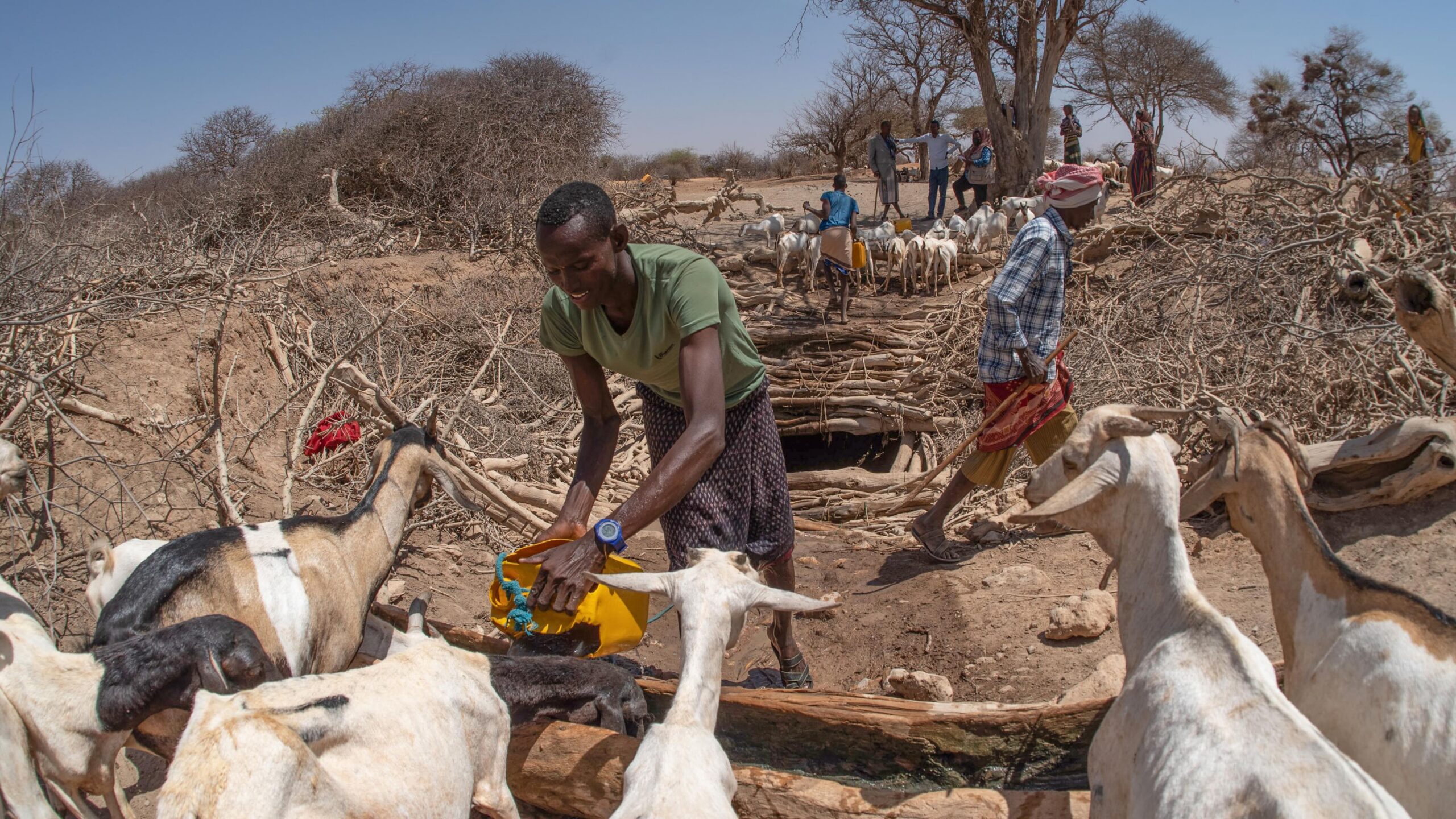
Banner image: The only water left for human and livestock to share in Berano Wereda, Homay Kebele of Ethiopia’s Somali region. Image by © FAO/Michael Tewelde.
Latest podcast episode: ‘We will not know what we lost’: Conservation fallout a year after USAID shutdown. Listen here:
Kebede, H. Y., Mekonnen, A. B., Emiru, N. C., Mekuyie, M., & Ayal, D. Y. (2022). Climate variability and indigenous adaptation strategies by Somali pastoralists in Ethiopia. Theoretical and Applied Climatology, 155(8), 7259–7273. doi:10.1007/s00704-024-04993-9
Feedback: Use this form to send a message to the author of this post. If you want to post a public comment, you can do that at the bottom of the page.…Read more by Latoya Abulu, Kaleab Girma