April 24, 2026
Grandma Moses: A Good Day's Work at Smithsonian Art Museum
One viewer’s embrace of sweet nostalgia is another’s artificial fantasy of yesteryear. Grandma Moses: A Good Day’s Work, organized by Leslie Umberger and Randall Griffey with Maria R. Eipert, Smithsonian American Art Museum, Eighth and G Streets, NW, Washington, DC, through July 12, 2026 Grandma Moses is an oddity of twentieth-century American culture. One of […]
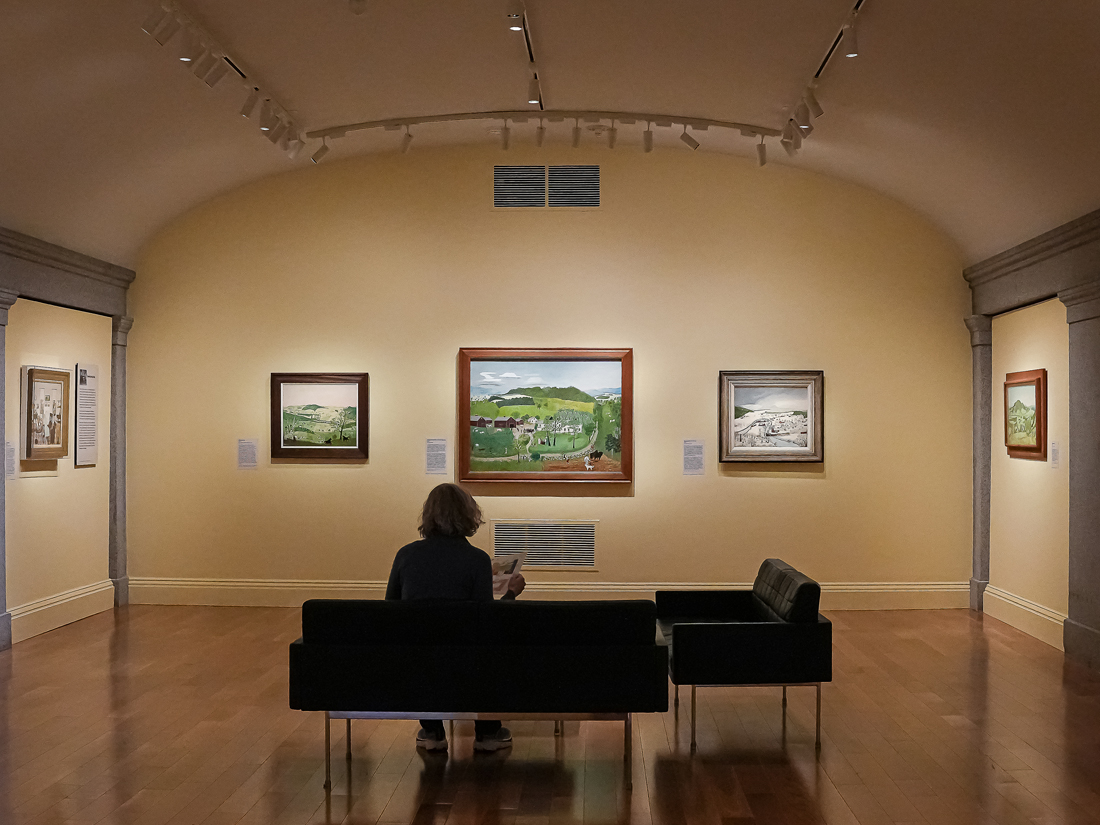
One viewer’s embrace of sweet nostalgia is another’s
artificial fantasy of yesteryear.
Grandma Moses: A Good Day’s Work, organized by Leslie Umberger and Randall Griffey with Maria R. Eipert, Smithsonian American Art Museum, Eighth and G Streets, NW, Washington, DC, through July 12, 2026
Grandma Moses is an oddity of twentieth-century American culture. One of the most successful female artists of her time, she was a self-taught painter of genuine instinct and unwavering work ethic—and one of the first to earn celebrity status. (As a household name, she preceded, and was perhaps only rivaled by, Andy Warhol). Beloved matriarch was the brand, and, at her hands, America pacified itself, suckling on a rootsy vision of its citizens as essentially good and peaceful, living in harmony with each other and nature (though during the decades in which she was active, the country was brutalized by—and brutalizing in—the Second World War, the Korean War, and the Vietnam War). As she created her mythical scenes, she became somewhat of a mythical figure herself.
Grandma Moses: A Good Day’s Work at the Smithsonian American Art Museum is excellent—a thorough, serious, celebratory retrospective—as is the catalog, which gives the artist her due heft as a sui generis cultural phenomenon. With eighty-eight paintings on view, as well as vitrines of dinnerware and teapots, cookie tins and Christmas ornaments, magazines and children’s books, and other means by which her art atomized into the American consciousness, the show presents a full portrait of this once-divisive artist. If the high-minded relished her outré aesthetic, and the general public embraced her candor and sweetness, not to mention its legibility and lack of pretention, the naysayers believed her to be little more than a grade-inflated amateur who delivered wistful, saccharine fantasies of an artificial yesteryear. Part of what makes Moses a fascinating study is that all of them had a point.
Moses had a long, full life before she had a career. Born Anna Mary Robertson in 1860 to a miller-farmer and his wife in Washington County, New York, she was one of ten children. She received little education and, at age twelve, went to work for a nearby wealthy family, who noticed her interest in their Currier & Ives prints and gifted her some chalk and crayons. In 1887, she married Thomas Salmon Moses, and the two moved to Virginia, where they spent twenty years or so as tenant farmers before returning to New York state. It was only at age seventy-eight that she took up the brush, in her words, “for pleasure, to keep busy and to pass the time away.” In 1938, Anna displayed a few of her pictures in a drugstore window in Hoosick Falls, New York, and collector Louis Caldor, who happened to be passing through town, bought them all. A year later, three pieces by “Grandma Moses” were featured in a private exhibition at the Museum of Modern Art. Thereafter, she took off like a shot.
Moses mostly made landscapes from memory—bucolic scenes of hills, trees, farms and farmhouses, and hardworking folks, all tranquil and valiant no matter the weather or season—and was determined to focus only on what she perceived to be the good in the world. Her subjects range from maple sugaring to harvest time to holidays like Christmas and Thanksgiving. Her people happily skate on frozen lakes, ride in horse-drawn buggies down smooth dirt roads or sleighs across trackless snow. They plant and harvest, they wave to their neighbors and gather to celebrate. Leslie Umberger, one of the show’s curators, notes that Moses approached composition with a “baker’s logic,” using a list of elements like ingredients that she could arrange and rearrange in different measures. This isn’t to say that her paintings are all alike, but that a viewer can closely study a single one and come to a respectable understanding of her process and product. In Cambridge Valley (1942), for example, she presents the view down a mountain as a patchwork of fields of various greens, roads cutting through as the seams, lined with thick forests and punctuated by lone trees, grazing spotted cows, and red barns. Faces have no pride of place for Moses; her hand, compromised by arthritis, conveyed feeling rather than reality.
While Modernism embraced the thrills and perils of the mechanical age, Moses became a machine. She produced an estimated 1,600 paintings in just over twenty years, transforming from an oldster hobbyist to a millionairess in the process. The art world called her a “modern primitive,” a label as belittling as it was good for business. No such thing as bad press. Together with the great and powerful gallerist Otto Kallir, she tirelessly promoted her art and herself on talk shows and appeared on the covers of Time and Life magazines. A licensing deal with Hallmark resulted in the sale of sixteen million cards in a single year. Her paintings hung in the homes of Harry S. Truman, Dwight D. Eisenhower, Bob Hope, Frank Sinatra, and Cole Porter, and when she died in 1961, at the age of 101, President John F. Kennedy paid tribute, claiming “Both her work and her life helped our nation renew its pioneer heritage and recall its roots in the countryside and on the frontier. All Americans mourn her loss.” His praise was so steeped in the rhetoric of American pride, one could reasonably start a conspiracy theory that the lovable little old lady was an agent for special ops.
Given her mainstream popularity, I was surprised by how disquieting her paintings are—concoctions that at first seem light, even enchanting, then appear deeply weird, haunted. The ghostly faces of the children in the otherwise bucolic tableau titled All Dressed Up for Sunday (ca. 1940); the trees blowing sideways and the heavy rain clouds pressing down on the family yard in Taking In Laundry (1951); the way the white house at the center of the verdant Hoosick River, Summer (1952) looks like it’s sinking into the same earth on which two little girls play: after spending time appreciating her devotion, her bright-eyed approach, and—yes—her unassailable painterly eye, I detected (or wished to detect) darker aspects to her vision. In the strangling, bracing context of America now, in which Trump’s administration has flexed some of its withering muscles over what can and cannot be displayed inside our cultural institutions, A Good Day’s Work can feel a conservative choice, but it does make instructive use of Moses’s long-standing divisiveness. Where some contemporary viewers will find succor in her scenes, others will recognize a nostalgia for a white America that never was. In this way, she is also a democratic choice, a woman who made something for everyone.
Jennifer Krasinski is a writer, critic, and senior editor at Bidoun.…Read more by Jennifer Krasinski