May 6, 2026
Casio G-Shock GMWBZ5000 Watch Review: The Modern Metal Casio Gets A Screen Update
The “full metal” G-Shock B5000 family (of which there are many sub-variants) of watches is among my favorite Casio models to spot on wrists in public. The people who choose these metal-bracelet Casio G-Shock watches clearly value both style and functionality. These are not even close to the most expensive G-Shocks you can buy (though […]
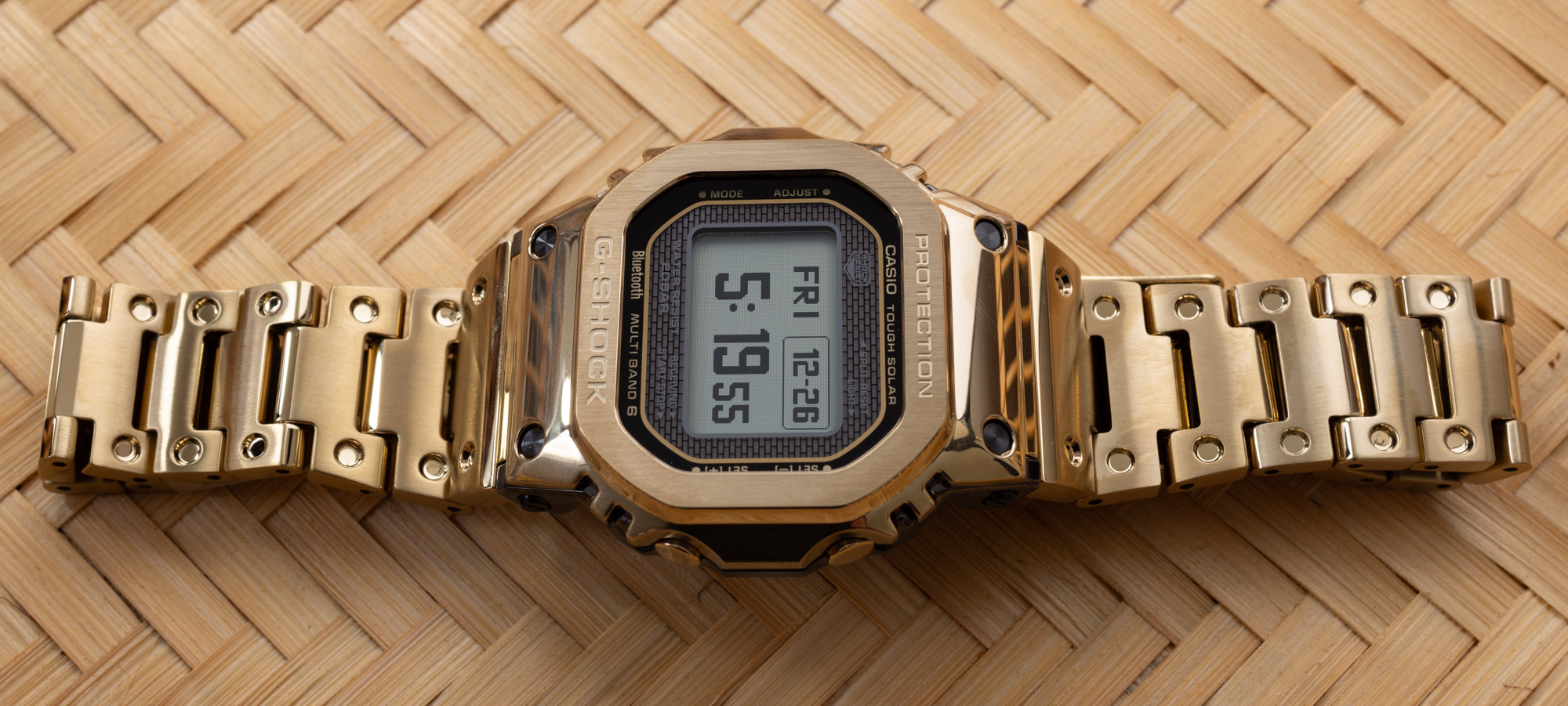
The “full metal” G-Shock B5000 family (of which there are many sub-variants) of watches is among my favorite Casio models to spot on wrists in public. The people who choose these metal-bracelet Casio G-Shock watches clearly value both style and functionality. These are not even close to the most expensive G-Shocks you can buy (though there are very expensive G-Shock watches that look very similar), but they are an intentional step up from the sportier G-Shock models you tend to see more commonly. In other words, the people who wear these products want both the reliability and performance of a Casio, but want a slightly more adult G-Shock-wearing experience. One of the newest members of the digital-face full metal watch family is the Casio G-Shock GMWBZ5000 (reference GMWBZ5000GD9 as pictured with the gold-tone steel). It offers a slightly new case shape and one of Casio’s first uses of a MIPs screen to replace the more traditional LCD screen display. I should also point out that even though in most of this article I compare MIPs versus LCD, the reality is that the memory-in-pixel screen is actually a form of LCD that Casio calls a STN-LCD. It is paired with a photovoltaic cell for solar charging.
Even though this is a very well-made watch with one of the most solid-feeling cases of the GMW-B5000 family, it is hard to suggest that this watch is a distinct upgrade or improvement over Casio’s more common, legacy liquid crystal display (LCD) screen technology. Some people have suggested that MIPs (memory in pixel screens) will eventually replace LCD screens, but I am not so sure. Rather than being an obvious upgrade from the LCD screen, the MIPs display is more like a different flavor. Albeit a flavor with a lot of unlock potential that Casio has not seemed to heavily dive into yet. So what can you say is the real upgrade here with the new display in the GMWBZ5000? I suppose, according to Casio, it is that the screen features a higher contrast and thus more legibility. Especially in very bright light conditions. That all may be correct, but I don’t know that these performance enhancements would be obvious to all, and they certainly aren’t remarkably dramatic.
Casio has a lower-priced black resin-cased G-Shock watch that also has the same MIPs screen. As of writing, that model is incredibly difficult to get and mostly sold out. There is clearly an interest in these screens and in general, in new Casio technology that is introduced into G-Shock watches. With that said, I don’t think there is a major rush to get a MIPs G-Shock or to feel that your LCD is old technology. Practically speaking, LCD screens can be nearly as legible (though MIPs do have a clear advantage in the contrast department) and offer more battery life. In fact, the battery life of a similar G-Shock watch with an LCD screen is an estimated 10 months (not in low power mode, which is longer). The MIPs-equipped version lowers that average battery life down to six months. That is still a long time, and both are solar-powered, so you can charge them via light. That said, it demonstrates that Casio still has some ways to go when it comes to at least matching the electrical usage efficiency of their LCD screen-based hardware modules.
One of the other potential advantages that memory in pixel screens has is that their higher-resolution screens allow for more graphical variety. That means that Casio was able (in theory) to create entirely new time displays and user interfaces for a watch like the GMWBZ5000. Did they? Well, sort of. One of the display innovations in this new system is a fresh font for the numerals that Casio calls “Standard.” The numerals are smoother and unlike the stencil-style numeric fonts of the LCD screens. There is a secondary font choice, which Casio calls “Classic,” and it simply emulates the look of stencil-style LCD numerals. No other font options or graphical layouts for the dial information are really offered. Although there are some new small options for some of the information that is displayed on the home screen. These are useful as you can choose to (for example) display a second timezone on the face for quick reference.
Casio does not make it easy to adjust the numeral font from Standard to Classic. That functionality is not available on the watch itself and is not even mentioned in the instruction manual a single time. Instead, you can only adjust the font via the Casio smartphone companion app. You’ll want this Bluetooth-enabled phone software because it very easily allows you to connect this and other Bluetooth-equipped Casio watches. When the watch is connected to the app, you can easily adjust its settings, update the time, and also adjust the display. It is generally very handy, but I cannot explain why with this new system, you can only adjust the dial font via the application and not natively on the watch device itself.
I encourage Casio to use MIPs technology in combination with fresh graphic design and novel user interfaces. Casio employs an insane amount of effort to get creative and cool with their analog-digital, or all-analog watch displays. The company clearly has the talent and the means to design some exciting time display concepts. I think it is about time that Casio again got interested in finding ways of freshening up their digital displays and offering some decidedly fresh display screens and fonts, in addition to known classics that everyone knows and already likes.
At launch, Casio’s full metal G-Shock collection has just two MIPs models, with this gold-toned GMWBZ5000GD9 featuring a normal light display, and the companion natural steel tone GMWBZ5000D-1 having a darker “negative” display. Ironically, I don’t know why the screens can’t natively switch between light and dark mode. They don’t appear to be bound by the same hardware limitations as LCD screens, so it initially seems arbitrary that Casio has decided to lock the screens in one display mode. I could be wrong, but my intuition tells me there is no reason why a MIPs screen cannot be immediately reprogrammed to have a light or dark style display. Issues like this are why I hesitate about recommending Casio lovers immediately upgrade to a MIPs display. It isn’t that they aren’t nice, but rather that Casio still seems to be working out some issues, while the technology right now is a bit more expensive and isn’t necessarily a game-changer, yet. Over the screen is a mineral crystal, as in the previous generation model. Higher-end Casio watches usually have a sapphire crystal, which is more scratch-resistant. While I don’t mind the mineral crystal here (as it is protected being recessed around the higher metal bezel), at this price point, Casio might want to start thinking about using sapphire crystals (if they can keep the production costs down since non-round sapphire crystals are much more expensive to machine than round ones).
To illustrate that fact, I have photographed the Casio G-Shock GMWBZ5000GD9 with the MIP screen next to the very similar GMWB5000GD9 with a negative LCD display. These watch reference numbers are only off by one letter. Casewise, there are some differences. Though it is unclear if they represent a real upgrade. Casio reengineered the black DLC-coated steel caseback for the GMWBZ5000 watch, and it looks pretty nice and feels very solid. The case continues to be water-resistant to 300 meters, and more or less has the same dimensions (43.6mm wide, 13mm thick), with a 49.3mm long lug-to-lug distance. Having said that, the watch case wears larger because the endlinks don’t really articulate down, effectively increasing the distance to 60mm. Thus, it is hard to recommend the GMWBZ5000 as being the best G-Shock for smaller wrists. Finally, the MIPs screen models are slightly heavier than the LCD models — 172 grams versus 167 grams.
This G-Shock’s software offers all the same features as the previous generation’s hardware. Though it doesn’t really add much. I will not go through an exhaustive list, but it includes useful features like a full calendar, stopwatch, countdown timer, up to five alarms, a world time function, Bluetooth features, six band atomic clock radio control, Tough Solar, and, thankfully, the auto-illumination feature that is not available in all G-Shock models. That latter feature (when activated) allows you to automatically activate the screen’s LED backlight when you lift up and turn your wrist at the right angle.
A note on the color of this gold-toned timepiece. There is something very fun about wearing a metal G-Shock in a gold color. Better if it were actual gold (Casio did that once), but overall, I like the ironic contrast between the color of a precious metal and the unpretentiousness of a digital display. Casio makes the world’s best wrist calculators, but they also make them stylish and fun. Much of what Casio wants consumers to appreciate in a watch is going to be missed by many consumers. They want people to appreciate the many details of the metal case for a relatively low price. They want you to be wowed by how shock and dirt-resistant the case is, despite having no exposed plastics and generally having a more formal (versus sporty) wearing presence. It will probably take a few more product generations before Casio starts going more mainstream with MIPs, and I certainly don’t think this technology is going to outright replace their traditional LCD screens anytime soon.
A next step for me is to have a meeting with an engineer at Casio to better understand the benefits and limitations of MIPs and where Casio feels it is with the technology. Many of my questions will probably be answered, and I can then get a better idea of how Casio plans to use memory-in-pixel screen technology for their wristwatch lineup in the years to come. An ambitious, albeit somewhat confusing product, the GMWBZ5000 is a futuristic metal Casio G-Shock that people have been eager about. Price for the Casio G-Shock GMWBZ5000GFD9 watch is $720 USD. For more information, please visit the Casio website.…Read more by Ariel Adams