November 3, 2026
Han Touts Nomination Reform, Oh Unity, Jang Livelihood in Conservative Contest
Opposition Contenders Move to Rally Support Forum Co-Hosted by People Power Party’s Seoul Chapter and City Government Jang Stakes Out Livelihood Agenda in Budget Season On Han’s Return to the Party, Jang Says It “Could Deepen Conflict Instead” Oh Says He Will “Meet Anyone and Listen to Their Views” Han Holds Forum With Kim Gi-hyeon […]
Opposition Contenders Move to Rally Support Forum Co-Hosted by People Power Party’s Seoul Chapter and City Government Jang Stakes Out Livelihood Agenda in Budget Season On Han’s Return to the Party, Jang Says It “Could Deepen Conflict Instead” Oh Says He Will “Meet Anyone and Listen to Their Views” Han Holds Forum With Kim Gi-hyeon and Yoon Sang-hyun “We Must Break the Structure Where Party Leadership Controls Nominations”
People Power Party leader Jang Dong-hyuk, Seoul Mayor Oh Se-hoon and independent lawmaker Han Dong-hoon each moved on the 3rd to claim leadership of South Korea’s conservative camp, pressing the themes of public livelihood, unity and nomination reform respectively. Han proposed writing bottom-up candidate nominations into law as he widened contacts with People Power Party lawmakers, while Oh sought to expand his base through a conservative alliance that cuts across factions. Jang asserted his presence with a policy agenda built around livelihood issues. With the acquittal of Oh on appeal sending ripples through the conservative camp’s power structure, the contest among the three contenders is growing sharper.
Han moved first. At 9:30 a.m. at the National Assembly members’ office building, he put the legislation of bottom-up nominations at the center of a forum titled “Party Reform: What and How,” attended by about 20 sitting People Power Party lawmakers. “The current structure makes it inevitable that nominations serve whoever holds party power rather than the party as a whole,” Han said. “For parties that operate partly on public subsidies, bottom-up nominations should be written into law.” The idea is to transfer nominating power concentrated in the party leader’s hands back to the public.
Han’s push for bottom-up nominations is seen as an attempt to distinguish himself from Jang, who has positioned the party as member-centered, and to broaden his support base within the People Power Party. To check a leadership that opposes his return to the party and to build friendly opinion inside it, he needs to extend his appeal beyond his own loyalists. The forum drew 18 sitting lawmakers, including Kwon Young-jin and Cho Eun-hee, who are counted as Oh allies, and National Assembly Vice Speaker Joo Ho-young, the party’s longest-serving member. The co-hosting of the event by five-term lawmakers Kim Gi-hyeon and Yoon Sang-hyun has been read as a sign that Han is exploring an alliance with the party’s old guard as well.
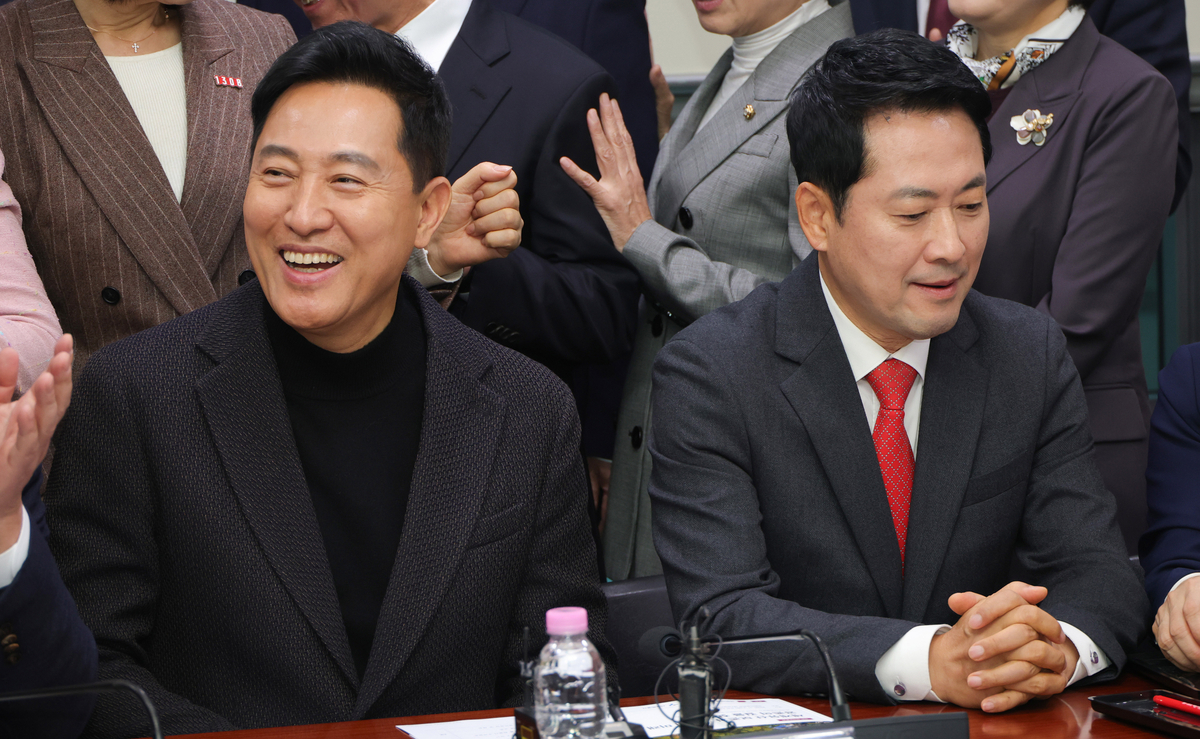
Thirty minutes later, at 10 a.m. in the same building, Oh stressed “grand conservative unity.” After attending a forum titled “World Heritage Preservation and the Future of Cities: Finding a Path to Coexistence,” co-hosted by the People Power Party’s Seoul chapter and the Seoul city government, he told reporters there was “no one I cannot meet and no one I cannot join forces with.” He added, “Going forward, I will visit anyone in our party, including Rep. Han, and listen to their views.” The remarks left the door open to alliances regardless of political closeness within the conservative camp.
Oh is widening his reach inside and outside the party, viewing a unified conservative camp as a precondition for victory in the 2028 general election. The move is seen as an effort to establish himself as the center of gravity for a unity that spans factions, strengthening his standing in the next presidential race. The forum drew 38 sitting People Power Party lawmakers, including allies of both Oh and Han as well as party leaders and senior members. With more than a third of the party’s 108 lawmakers gathered in one place, some said it resembled a full party caucus.
Jang, however, showed a gap with Oh on conservative unity. Speaking at the same forum, Jang emphasized cooperation with the Seoul city government but restated his opposition to Han’s return to the party. “If unity and alliance instead deepen conflict, that runs counter to the point,” he said, indicating he would decide by asking party members. Unlike Oh, who left room for an alliance with Han, Jang held to his negative position by citing opinion within the party.
After the forum, Jang moved to party headquarters and personally announced the party’s approach to next year’s budget review. A party leader taking on the announcement of budget review priorities, a task usually handled by the floor leadership, is read as an attempt to lead the livelihood agenda during budget season. “To increase good spending, there is bad spending that must be cut by the same amount,” Jang said, taking aim at the Lee Jae-myung administration. In the afternoon, he attended the first on-site meeting of a youth housing task force, held at E-Land PEER Sinchon, a privately operated rental housing complex in Seoul’s Mapo district, to take up housing issues facing young adults.
Analysts say Jang’s string of livelihood events also reflects calculations about the next race for party leadership. With lawmakers such as Lee Jin-sook, Kim Tae-gyu and Joo Jin-woo building their profiles on the support of hard-line conservatives, Jang is seen as seeking an edge in that race by staking out economic and livelihood issues while maintaining a clear line of confrontation with the governing party. The Yeouido Institute, the party’s think tank, holds a breakfast meeting every Wednesday that is also described as a venue for developing policy tasks to support the leadership’s livelihood agenda.…Read more by Seoul Economic Daily