November 26, 2026
Korea’s 3 major carriers to offer nationwide standalone 5G services
Korea’s three major mobile carriers will launch nationwide commercial 5G standalone (SA) networks starting next month. The ability to divide a single 5G network and offer companies dedicated network-like services is expected to spur competition among carriers in the corporate 5G market. The Ministry of Science and ICT held a joint public-private event with the […]
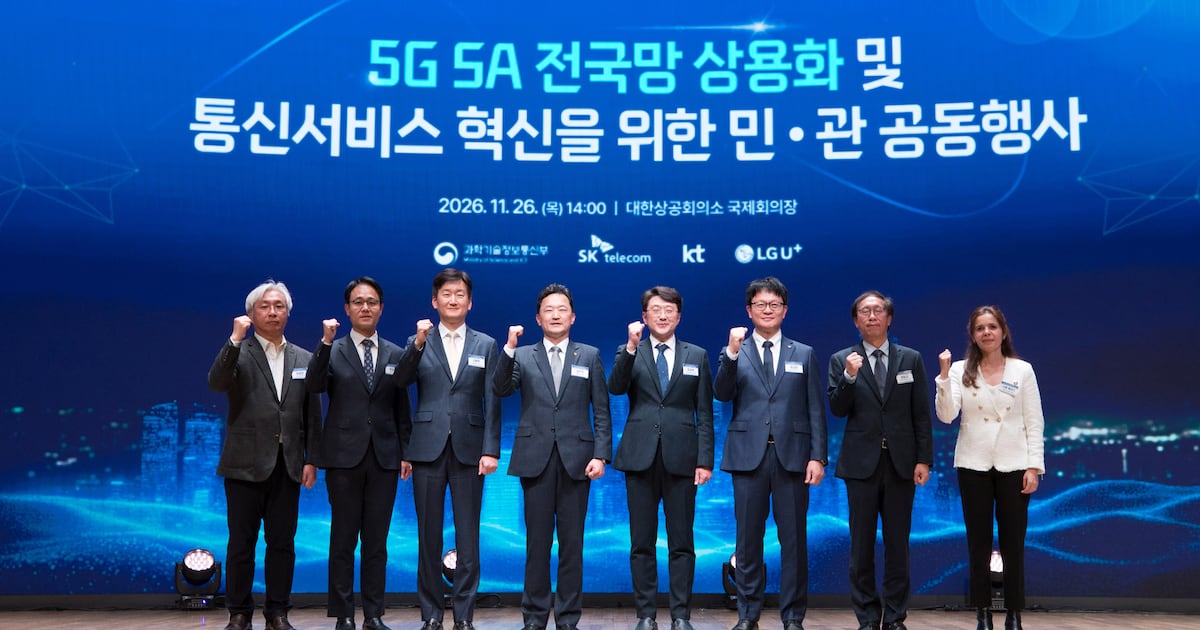
Korea’s three major mobile carriers will launch nationwide commercial 5G standalone (SA) networks starting next month. The ability to divide a single 5G network and offer companies dedicated network-like services is expected to spur competition among carriers in the corporate 5G market.
The Ministry of Science and ICT held a joint public-private event with the three carriers at The Korea Chamber of Commerce & Industry in Seoul on the 26th to mark the commercial launch of nationwide 5G SA networks and promote telecommunications service innovation. The ministry presented related policy and service plans.
A 5G SA network uses 5G technology throughout, from the base stations that transmit and receive radio signals to the core network that processes them. It enables customized services based on 5G features such as low latency, high reliability and network slicing, which divides a single network into multiple independent virtual networks.
KT built a 5G SA network in July 2021, and LG Uplus and SK Telecom plan to launch commercial 5G SA services on Nov. 30 and Dec. 1, respectively.
The three carriers presented their preparations for the commercial launch of 5G SA and their future service plans at the event.
KT shared its experience operating a nationwide SA network, including a field trial at the Busan Fireworks Festival. It also showed a demonstration video of 5G app slicing, a technology that allows different apps on the same smartphone to use different networks, and outlined plans to launch a corporate security service.
LG Uplus said it plans to run a 5G SA trial group at a baseball stadium on Dec. 5 and expand its 5G SA services to industry and public sectors such as firefighting and emergency medical care.
SK Telecom presented plans for a pilot service to maintain stable communications quality for subscribers in crowded settings such as festivals and concerts. It also outlined its vision for corporate services, including robot control at industrial sites.
The government said it would allow reasonable variations in service quality to encourage the launch of customized services as 5G SA develops, while maintaining the basic principles of net neutrality: protecting general internet quality and prohibiting preferential treatment for specific apps or content. It also said it would clarify the criteria for recognizing specialized services that require specific quality guarantees. Starting with public and safety applications such as firefighting and emergency rescue communications, the government said it would promote new customized services, including dedicated corporate security networks and services for robots and drones. It also said it would encourage continued expansion of network capacity as users and services increase, alongside improvements in quality in underserved areas.
The government also decided to conduct trial measurements this year using indicators such as 5G SA connection retention rates and latency. It will develop additional 5G SA-specific indicators from next year onward and overhaul the assessment system to measure the quality users experience.
“Above all, it is important to identify services that the public can experience firsthand and create tangible value at industrial sites,” said Choi Woo-hyuk, head of information security and network policy at the Ministry of Science and ICT.…Read more by Ko Sung-min