May 30, 2026
Eureka Sales Tax Revenue ‘Pointed in One Direction and That’s Down’
Eureka is in a situation familiar to other Humboldt County cities – its costs are rising at an alarming rate and its revenues are comparatively weak. The sorry state of Eureka’s budget was explored during a May 26 joint meeting between the Eureka Council and the city’s Finance Advisory Committee. Finance Director Lane Millar gave […]
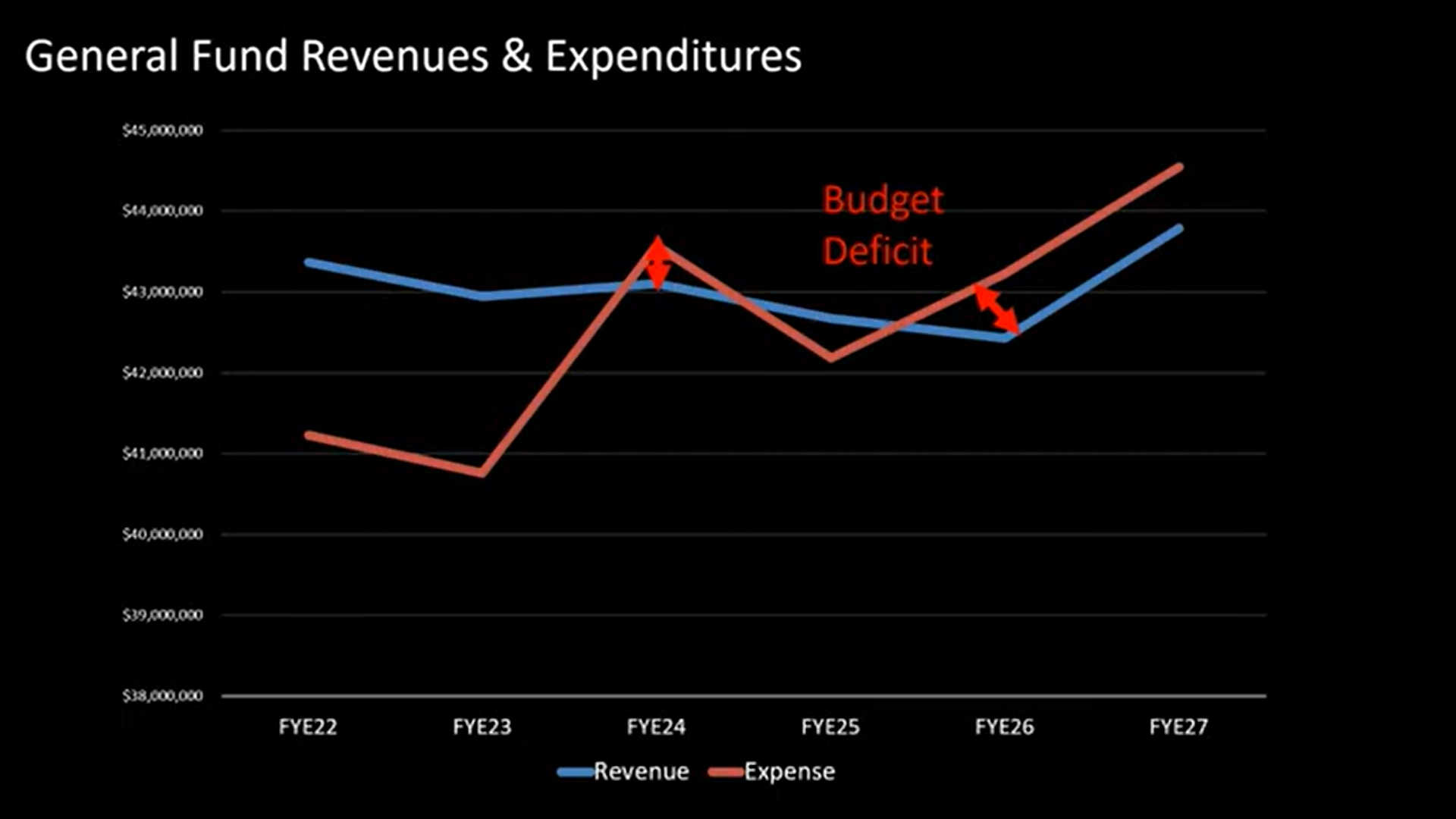
Eureka is in a situation familiar to other Humboldt County cities – its costs are rising at an alarming rate and its revenues are comparatively weak.
The sorry state of Eureka’s budget was explored during a May 26 joint meeting between the Eureka Council and the city’s Finance Advisory Committee.
Finance Director Lane Millar gave a presentation on the budget that flagged several troubling issues.
“Sales tax revenues have decreased over time and continue to stay flat, and most expenditure increases are out of our control,” he said.
That’s resulted in a budget deficit of $800,000 in the current fiscal year.
The projection for the next fiscal year beginning July 1 is a modest 2 percent growth in tax revenue. But even that slight improvement is in doubt.
It’s based on a forecast by HdL Companies, the city’s contracted financial consultant. Councilmember Renee Contreras-DeLoach has heard it before and as before, she isn’t buying it.
“I feel like I’ve spent three-and-a-half years arguing with this these numbers and we have declined and declined and declined and declined,” she said. “I’ve just kept saying it and I’m going to argue with them again – we should not plan on it, it will be a mistake to plan on it and it’s been a mistake.”
She added that it “does make sense, right?” to “listen to the professionals” but “they’re wrong and they’ve been wrong.”
Contreras-DeLoach noted Eureka’s location as a “rural area” where “the recession began sooner, and by years.” She reiterated her doubt about HdL’s forecast.
“I don’t want to count on an increase, if anything I would like us to come up with a plan for how we’re going to deal with a decrease,” she said.
Eureka isn’t alone in dealing with a sluggish economy.
“The City of Arcata and the City of Fortuna, they’re very similar, they’re having budget issues too,” said Millar. “And when you see that everyone’s struggling with their sales tax numbers, it’s telling you that our local economy might be contracting.”
Sales tax is crucial to the budget, accounting for 60 percent of its revenue. Millar showed a graph detailing the sales tax revenue trend since the 2021-22 fiscal year and described its trajectory.
“You can see that it’s kind of pointed in one direction and that’s down,” he said.
Meanwhile costs are going way up, with employee salary and health insurance costs expected to rise by $1.3 million in the coming fiscal year.
Employee retirement fund payouts and liability insurance are also increasing by roughly equal amounts, for a combined total of about $800,000.
Of the retirement fund costs, Millar said “about $300,000 of that is going to hit the police’s budget.”
The mayor and council are up for pay raises that will go before voters this November but regardless of how that turns out, health insurance costs for the mayor and council will rise by $47,000.
What can the city do to offset the cost quake? Councilmember Leslie Castellano suggested some approaches.
Acknowledging that “sometimes in deficit times it’s difficult to think about investing,” she recommended “investing in economic development opportunities.”
Those include utilizing the bayfront Halvorsen Park into “more of a consistent venue” and building upon the Holiday Lights program to establish the city as the “destination shopping area for people throughout the region” during the Christmas season.
Castellano also referenced San Francisco’s SF New Deal program, which was created during the COVID era and uses a non-profit organization as a springboard for small business development.
“We can of course continue to recruit large industries such as wind but in the meantime we have small businesses that that I think could grow,” she continued, citing home-based businesses and “cottage industries” as examples.
The budget also includes cost reductions, with city departments cutting their budgets by 2.2 percent. It has more impact than might seem.
“2.2 percent might not sound like a lot but if you’re the Police Department and your budget is $18 million, 2.2% is about $400,000,” said Millar. “It starts to get really hard when you’re a big budget.”
The city council will review the draft budget on June 2 and final adoption is set for June 16.…Read more by Daniel Mintz