June 4, 2026
Mouse Embryos in Space: China’s Station Reveals Life Development Secrets – Newsy Today
The Next Frontier: Can Life Begin Among the Stars? For decades, humanity has looked to the stars with one primary question: Can we live there? While we have mastered the art of sending humans to orbit, we are now entering a much more complex phase of space exploration: understanding if life itself can spark and […]
The Next Frontier: Can Life Begin Among the Stars?
For decades, humanity has looked to the stars with one primary question: Can we live there? While we have mastered the art of sending humans to orbit, we are now entering a much more complex phase of space exploration: understanding if life itself can spark and thrive in the vacuum of space.
Recent breakthroughs from the Chinese Academy of Sciences (CAS) have shifted the conversation from science fiction to biological reality. By successfully culturing mouse embryos aboard the Tiangong space station, researchers are peeling back the layers of how microgravity and cosmic radiation impact the very first stages of mammalian development.
The challenge of conducting embryology in orbit is immense. It isn’t just about survival; it’s about the precision of life. The research team from the Shenzhen Institutes of Advanced Technology (SIAT) had to overcome the hurdles of limited space and extreme environmental constraints.
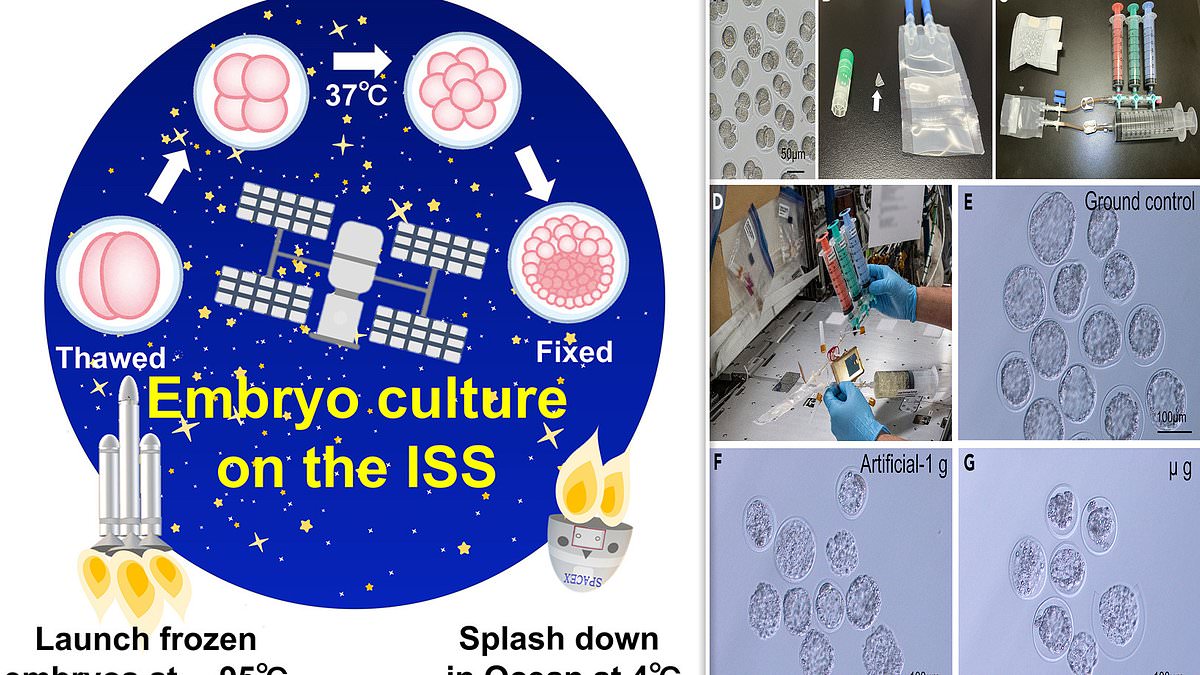
The solution? A custom-designed embryo microfluidic chip culture box. This device allowed for real-time imaging and automated nutrient perfusion, effectively mimicking the conditions of a controlled laboratory environment while traveling at thousands of miles per hour above the Earth.
Pro Tip: Microfluidics is the game-changer for space biology. By shrinking laboratory functions onto a single chip, scientists can conduct complex biological experiments with minimal power and space requirements—a necessity for long-term Mars missions.
Why Embryonic Development is the “Final Boss” of Space Travel
If we intend to become a multi-planetary species, we must eventually address the biological viability of reproduction. Understanding mitochondrial damage and epigenetic modification abnormalities in space-grown embryos provides the “theoretical foundation” for future human habitation.
According to NASA’s Human Research Program, long-term exposure to space radiation and microgravity poses risks to human health that we are only beginning to quantify. By studying mouse embryos, we are essentially running a “canary in the coal mine” test to see if the building blocks of life can withstand the stresses of the cosmic environment.
• Zygotic Genome Activation: Determining if the “on-switch” for life functions normally in space.
• Environmental Resilience: Assessing the impact of radiation on genetic integrity.
This isn’t the first time we’ve sent life into the void. Since the European Space Agency’s early experiments and China’s Shijian satellite missions, the progress has been exponential. In 2016, researchers achieved the “holy grail” of early space experiments: watching a mouse embryo develop from the 2-cell stage all the way to the blastocyst stage.
Did you know? The blastocyst stage is critical because it is the point at which cells begin to differentiate, setting the blueprint for the entire organism.
What do you think is the biggest hurdle to human colonization of Mars? Is it the technology, or the biology? Join the conversation in the comments below, or subscribe to our weekly science briefing for the latest updates on space exploration.…Read more by Chief Editor