July 22, 2026
TOWNFALL: Many South Carolina towns are broken — plagued by infighting, corruption and mismanagement. Here’s how to fix them.
A growing number of South Carolina towns and cities have become dens of corruption or incompetence as experienced administrators quit and public officials botch the books or flat-out steal from the people they’re supposed to serve. From Elloree to Bonneau to Cottageville, many towns are in “accountability deserts” where news coverage evaporated and other watchdogs […]
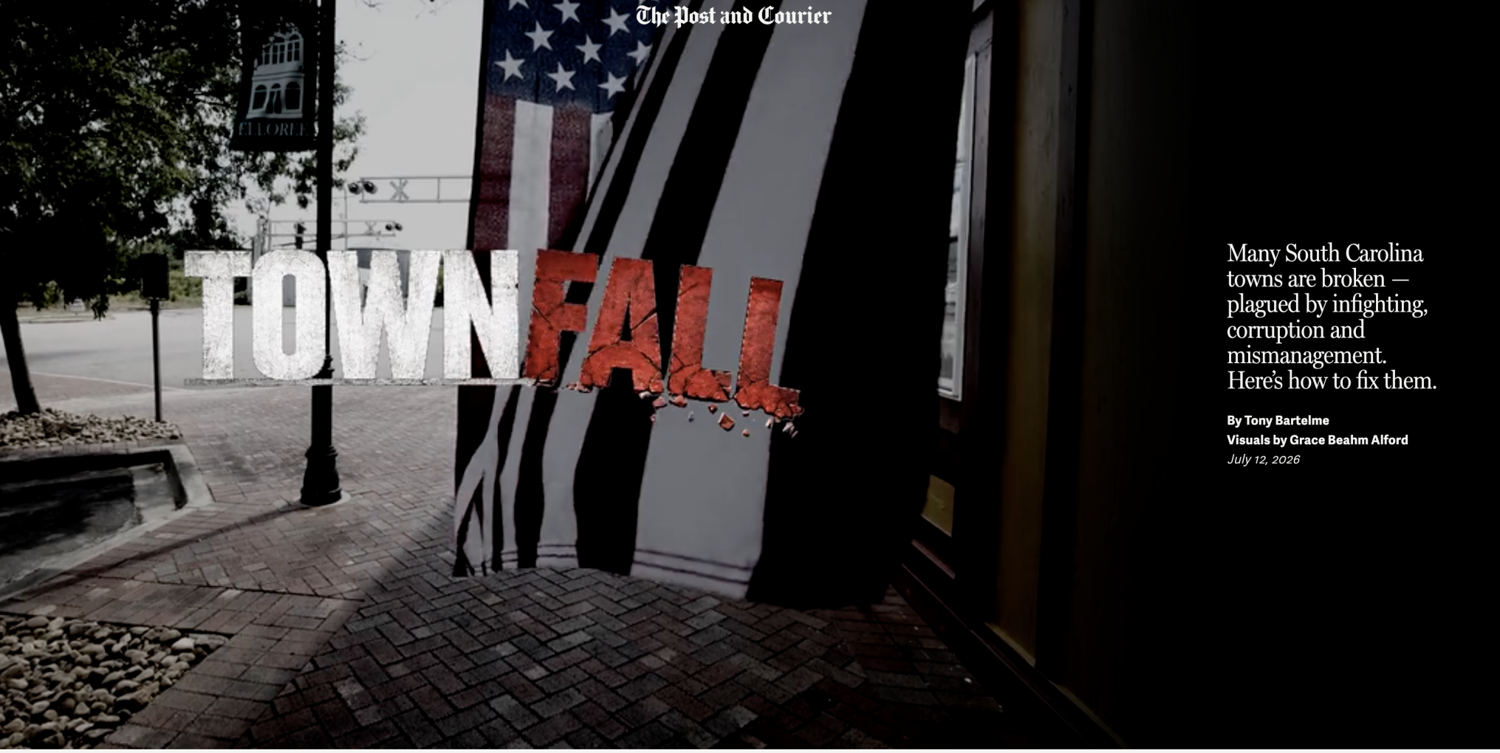
A growing number of South Carolina towns and cities have become dens of corruption or incompetence as experienced administrators quit and public officials botch the books or flat-out steal from the people they’re supposed to serve.
From Elloree to Bonneau to Cottageville, many towns are in “accountability deserts” where news coverage evaporated and other watchdogs failed in their oversight roles, a new Post and Courier Uncovered investigation found. In these accountability deserts, cronyism and dysfunction can fester, bleeding towns of money and trust.
We’ve seen it in Florence County’s Lake City, which was on the verge of bankruptcy even as town officials went on junkets.
And in Abbeville County’s debt-plagued Calhoun Falls, which had to shutter its city hall after four years of operating without an official budget.
It doesn’t have to be this way.
The Post and Courier’s analysis mapped these accountability deserts and identified key warning signs for towns that might be vulnerable to corruption. It revealed ways that the state could make municipalities more transparent.
The analysis is rooted in The Post and Courier’s years of accountability work. Since 2018, that coverage factored into criminal charges against at least 24 public officials, including powerful sheriffs and court clerks — people sworn to uphold our laws. The coverage also played roles in 17 noncriminal matters that led to new legislation, tighter spending practices and judicial reprimands against officials who used their positions for personal gain.
In the process, Uncovered project journalists gained new insights into how towns operate and fall short.
Across South Carolina, towns and cities are failing to properly keep track of taxpayers’ money. More than 70 municipalities haven’t done financial audits as required under South Carolina law. In other words, roughly one in four of South Carolina’s 271 municipalities aren’t giving their taxpayers a full and independent picture of their spending. Some haven’t turned in their audits for more than a decade. They’re breaking state law.
These audit scofflaws are leaving more than $9.2 million in state funding on the table — money many of these towns desperately need. South Carolina’s treasurer withholds money from towns that don’t turn in their financials. That hasn’t stopped towns from flouting the law.
The number of audit delinquents increased dramatically during the past three years, a troubling sign. Many towns on the audit delinquency list have been hit with misconduct scandals.
South Carolina has a smorgasbord of cases involving corruption, waste and questionable conduct — more than 120 examples over the past 10 years. This roster includes Spartanburg County’s embezzling former Sheriff Chuck Wright and the federal corruption case in North Charleston, which swept up three of the city’s 10 council members. No corner of the state has been untouched, but rural areas seem to be hotbeds of mischief — where accountability often is weakest.
The costs of municipal dysfunction are real and often fall on county taxpayers. During the past year, Florence County alone loaned about $1.65 million to Lake City, $395,000 to Pamplico and $425,000 to Johnsonville because of mismanagement or audit delinquency in those communities. “Do you want three of your (county’s) nine municipalities to file for bankruptcy or default on a bond?” Kevin Yokim, Florence County’s administrator, said of the stakes.
South Carolina lawmakers have done almost nothing about this. Other states, including North Carolina, have extensive support systems to help struggling towns — and severe consequences if they don’t fix their problems. That kind of scrutiny and assistance doesn’t exist in South Carolina.
Taken together, these factors and the decline of community newspapers helped create our accountability deserts. Towns in these areas are more likely to get stuck in failure doom loops, where questionable leadership breeds cynicism and distrust. This can make it even more difficult for honest public officials to fix things.
But the newspaper’s findings include potential solutions to stop the spread of South Carolina’s accountability deserts.
And one path leads across the border.
The 1929 stock market crash wiped out the bank accounts of people and cities alike. Western North Carolina’s city of Asheville had massive debts, and 18 bankers and municipal officials eventually were indicted on fraud charges, including the mayor, who shot himself and died. By 1933, more than 400 North Carolina governments were broke. Desperate lawmakers came up with a fix — a new Local Government Commission and a future national success story.
North Carolina’s nine-member commission includes the state’s top officials: the treasurer, auditor and secretaries of state and revenue, along with five appointees. They oversee billions of dollars a year in municipal borrowing. They can nix a town’s ability to issue bonds if the budget numbers don’t add up.
The commission also requires towns to turn in audits six months after their fiscal years end. South Carolina’s rule is 13 months. North Carolina commission staff then use the audits to identify signs of fiscal stress: towns dipping into fund balances or unusual transfers between accounts.
Municipalities with enough red flags end up on a “Unit Assistance List.” But the public shaming also comes with help — accounting and planning resources. Commission staffers see themselves as coaches. And like coaches, they sometimes push town leaders to do things they’d rather not do, such as raising taxes and laying off employees.
If the coaching fails, the commission can take financial control of a town or dissolve it for good.
Which is what the commission was considering last April.
The room was tense. Residents from Rocky Mount had threatened to come to Raleigh and protest. But they weren’t angry with the commission; they were fed up with how their own elected leaders had driven the city into a ditch.
Rocky Mount is a city of about 54,000 people in east-central North Carolina, the home of jazz great Thelonious Monk. For decades, Rocky Mount was an urban leader. In 1969 and 1999, the National Civic League named it an “All-America City,” an honor given to just 10 municipalities a year.
But now Rocky Mount was a model of failure. A turning point came in 2021, when the city lost its longtime finance director. The city cycled through four more finance officers with little government accounting experience. The city hired a manager from Virginia with a record of overspending, and that soon happened in Rocky Mount, as well. By early 2026, the city was months away from running out of money. The commission summoned city officials to Raleigh to explain themselves.
In a booming, chamber-of-commerce voice, Mayor Sandy Roberson offered optimism and apologies, telling the commission that city officials were doing the best they could. Elton Daniels, the city’s new manager, got more to the point. He said the city had just raised utility rates by 15 percent, cut more than 100 staff and brought in outside financial help. Commissioners seemed impatient.
“My recommendation and my sort of expectation would be that we would have a mass resignation of city council now,” said Dave Boliek, the state auditor.
Treasurer Brad Briner noted that in the commission’s 94-year history, the state had taken over only 12 municipalities. “It almost never gets this bad,” Briner said. Rocky Mount’s problems were self-inflicted. “This is simply a failure of will — and we are here to help impose that will today.”
Next up were the folks from Littleton, a town with fewer than 500 people near the Virginia border. Littleton’s leaders hadn’t submitted audits in five years. Denise Canada, the staffer who runs the commission, set the tone. Audits aren’t done just to check a box, she said.
“It’s having updated financials so you can soundly run your government, keep the water running,” Canada said. “… So I’m very concerned about your ability to continue functioning, but with that said, we’re glad you’re here.”
Mayor Heidi Hogan, in her mid-80s, sat at a white table and tried to explain what went wrong. She said town officials gently prodded the accountants to do the work. But “they would tell us, ‘It’s tax season.’ ” Years passed, and the audit backlog grew. The mayor said she feared the accountants might not do the town’s financials at all. “We kept thinking, ‘Well, we don’t want to annoy the auditor.’ ”
Commissioners like Boliek weren’t buying it. He said he would have gotten in his car “and driven down there and sat in the lobby and said, ‘We’ve got a real problem here … We need to get this fixed.’ ” Canada also was skeptical. “Ultimately, if you’re going to run a town, you have to run the town.”
It all had the feel of substance-abuse interventions, but instead of narcotics, officials were caught in cycles of mismanagement. The threat of a state takeover hung in the air. After a few moments, the members decided to give Rocky Mount and Littleton one last chance: Show meaningful progress in the coming weeks or else. Commission staffers would help them as much as possible.
But next month’s meeting would be pivotal.
Some North Carolina towns bristle under the Local Government Commission’s scrutiny. But ratings agencies such as S&P Global and Moody’s consistently laud that state’s oversight muscle. Today, North Carolina has more local governments with two or more AAA ratings than any other state, according to an analysis this year by North Carolina’s municipal advisors.
Higher credit ratings usually translate into lower interest rates, which ultimately save tax dollars when towns and cities borrow money, said Briner, the treasurer.
North Carolina isn’t the only state that closely monitors the fiscal health of local governments. Nevada looks at 27 indicators, such as cash levels and revenue. Tennessee and Pennsylvania look for signs of financial weakness and offer accounting help before the distress turns into an emergency.
All told, at least 23 states have systems for monitoring or responding to local fiscal distress, according to a report by The Pew Charitable Trusts.
The state does have some tools. Since 2009, South Carolina law required municipalities to turn in their financials every year. The law also gave the treasurer power to withhold state funds if municipalities didn’t comply. In 2024, lawmakers loosened the rules for smaller towns, allowing them to submit simpler “financial compilations” instead of full-blown audits.
Even so, more than 70 of South Carolina’s 271 municipalities are behind. That’s one in four. If patterns in recent years hold up, that number will grow in the coming months as more towns and cities miss their deadlines.
Some municipalities haven’t done audits for years. Newberry County’s town of Peak, population 54, has 15 years of missed audits. And Saluda County’s town of Ward, population 124, holds the deadbeat record — 17 years.
One pattern is clear: Towns with fewer than 1,000 people are twice as likely to be delinquent as larger municipalities, The Post and Courier analysis found.
Also troubling: The number of delinquent municipalities doubled between 2014 and 2025, with a significant increase in delinquency during the past three years.
Many mayors and local government experts cite one under-the-radar trend that’s driving this noncompliance — the shortage of qualified finance officers and government accountants.
Nationally, 62 percent of local government finance workers are older than 50, according to research by George “Mac” McCarthy, former president and chief executive officer of the Lincoln Institute of Land Policy in Cambridge, Mass. Amid this looming wave of retirements, fewer young people are entering the field. “It’s not just a temporary shortage,” McCarthy said. “It’s a broken pipeline.”
The town of Reevesville in Dorchester County had nine years’ worth of missing audits. “This year we did an audit, and we thought it would be cheap enough, and that we’d get a little bit of money back from the state,” said Tom Kittrell, the mayor. “But then we got socked with a big bill.” He said the accounting work cost about $11,000, and that the town’s budget was in “the mid-30,000s” so the process just “isn’t feasible.”
Yet the failure to do annual audits can be a poker tell for deeper issues.
Take what happened in Calhoun Falls, a town of about 1,800 near the Georgia border.
Calhoun Falls was a long-standing audit delinquent, which triggered an investigation last year by South Carolina’s Inspector General.
Investigators found a stunning portrait of incompetence and possible fraud. The town failed to adopt budgets in 2023 and 2024, and it was more than $600,000 behind on its bills. Yet officials spent thousands of dollars on snacks and meals.
The State Law Enforcement Division launched an investigation, and the mayor temporarily shut down town hall amid a mass resignation. Officials with the city of Abbeville, about 20 miles away, recently talked about taking control of Calhoun Falls’ water and sewer utility, the Greenwood Index-Journal reported. One Calhoun Falls official openly spoke about the town losing its incorporation status altogether.
Given that audits can be early warning signals, The Post and Courier used audit delinquency data to create a map of South Carolina accountability deserts — communities with weak oversight, declining local news coverage and histories of corruption or mismanagement that may leave them vulnerable to fiscal distress.
You can find a town in one of these accountability deserts just an hour’s drive northwest of Charleston.
Elloree is in a quiet corner of Orangeburg County, its roots planted in cotton farming and as a railroad stop. But Interstates 26 and 95 bypassed Elloree, and the town began to hollow out. Its population today is about 550, a drop of roughly half since the 1960s.
During that heyday, its downtown was packed with people and thriving stores. Today, it still has a beautiful row of historic brick buildings with overhanging porches, but many are empty. One has a caved-in roof.
Behind the old town hall is an ominous one-room jail, now unused, with a plaque that reads “GUARD HOUSE built in 1904 by J.K. ULMER, SR. with bricks made in his kiln.” It’s a testament to the family’s influence. The Ulmers have been in Elloree since the late 1800s, and today, the jail-builder’s great-grandson, James “Kelly” Ulmer IV, is mayor.
Ulmer won November 2025’s election in a three-candidate race, receiving 85 of the town’s 203 votes. He did so despite a history of criminal charges in Orangeburg County and Florida, a record he declined to discuss.
Ulmer is mayor of a town with a budget of about $742,000, a three-person police force, a water system and a block-long parade of dramas.
Three years ago, SLED arrested Elloree’s police chief after a video surfaced of him damaging someone’s car with “an unknown object,” according to warrants filed at the time. The chief retired, but his successor, David Martin, uncovered “potential criminal behavior and mismanagement,” according to a lawsuit he later filed against the town. Martin also alleged that town officials fired him because he started asking questions.
Meanwhile, Elloree settled another lawsuit for $300,000 that accused police of falsely imprisoning a resident. Two residents started a podcast about the turmoil, “Left, Right & Local,” which they described as “a fearless dive into backwater scandals, secrets and power struggles.”
Ulmer called the podcast “disgusting” but said he hadn’t listened to it. Amid all the drama, the town’s failure to do its audits might seem like a minor act. But the state treasurer is withholding $16,602 in state funds as a result. “We’re behind two years right now,” Ulmer said, adding that when he recently looked at the state’s audit delinquent list he didn’t “feel near as bad. I mean (nearby) St. Matthews is behind five or six years.”
Like the mayor of North Carolina’s troubled town of Littleton, Ulmer blamed busy accountants.
Unlike North Carolina, South Carolina hasn’t forced Elloree to comply with the law.
Elloree is just one example of towns with ingrained power structures and limited transparency.
There’s also Pelion, a town of about 620 people in Lexington County. A former police chief said in a sworn affidavit that he received $500 from a town council member, which he felt was a “quid pro quo” to turn a blind eye to misconduct.
And Hampton County, home of the Murdaugh family, which spawned a cottage industry of books describing small-town corruption that eventually led to the dramatic murder trial — and a pending retrial. The court cases attracted global attention at the same time local activists struggled to get an audit into $5 million in missing money from a county sales tax.
And Lake City, which was teetering on bankruptcy after years of mismanagement and overspending, including tens of thousands of dollars on junkets by elected officials. The situation was so dire there that billionaire philanthropist Darla Moore said in a public forum that her hometown’s failures had left her “pistified” — “pissed off and mystified at their stupidity at the same time.”
5. Would the North Carolina towns get another chance?
Back in Raleigh, the North Carolina Local Government Commission was set to meet again. A month had passed since the commission’s warning letters and tongue-lashings.
Would Rocky Mount have its finances in order?
Did Littleton find someone to work on its lapsed audits?
But first the commission had to move forward with the dissolution of a town named Speed, population 63. Speed had failed to submit audits for five years, keep accurate minutes of meetings and do other basic things towns need to do in 2026. Residents there had agreed to give up the town’s charter for good.
No one from Speed showed up at the meeting. It was time for Rocky Mount and Littleton.
The mood seemed to lighten when Rocky Mount’s city manager, Elton Daniels, said he had good news. Spending cuts were kicking in; the city’s finances were stabilizing. Brad Briner, the treasurer, joked that Daniels should show up to their meetings more often.
The town’s mayor, Heidi Hogan, sat at the table and launched into a long discussion about the town’s water and sewer issues. She talked about how commission staff had given town officials important advice, including a way to hire a full-time finance director. She thanked the commission over and over.
“You gave us that extra push, and that made a difference.”
“If I may interrupt. I think you have buried the lede. This weekend …”
She paused to let the mayor finish the sentence.
“… I almost can’t say the words,” the mayor said. “The audit was submitted.”
And the commission members broke into applause.
• The dark and light sides of a South Carolina town in an “accountability desert.” Will it survive?
• The state is holding millions of dollars back for these South Carolina towns that failed to do basic audits.
• A gift or something else? Power and police in Pelion.
• Solutions to help stop the spreading accountability deserts.…Read more by By Tony Bartelme