July 20, 2026
Who in Iran Is Threatening Donald Trump?
Ten days ago, following Islamic Revolutionary Guard Corps (IRGC) attacks on commercial vessels in the Strait of Hormuz and while the body of Ali Khamenei was still in Iraq, Donald Trump announced the end of the ceasefire with Iran. However, verbal threats from various Islamic Republic officials against Trump and American leadership had already been […]
Ten days ago, following Islamic Revolutionary Guard Corps (IRGC) attacks on commercial vessels in the Strait of Hormuz and while the body of Ali Khamenei was still in Iraq, Donald Trump announced the end of the ceasefire with Iran. However, verbal threats from various Islamic Republic officials against Trump and American leadership had already been mounting for days. From a written message by Mojtaba Khamenei vowing “revenge” against his father’s killers, to MP Sattar Hedayatkhah asking women at a rally to drop their gold into his hat to fund the retaliation, to Hossein Shariatmadari writing in the Kayhan newspaper during Trump’s visit to Turkey that “Trump must not remain alive” – how serious are these threats to a United States that has targeted Iran’s southern provinces with bombs and missiles?
What Do We Know About Iranian Officials’ Threats Against Trump?
The sparks for the latest wave of threats against Donald Trump’s life during the final days before the ceasefire lapsed on July 7 were struck by Naser Makarem Shirazi and Hossein Noori Hamedani, two state-aligned clerics who issued rulings declaring those threatening the Supreme Leader as Muhareb (combatants against God).
On July 2, clerics from the Tehran Seminary issued a joint statement branding US President Donald Trump and Israeli Prime Minister Benjamin Netanyahu as Kafir Harbi (belligerent infidels), Mofsed-e-fil-arz (corruptors on Earth), and Mahdoor al-Dam (those whose blood may be spilled with impunity). This “juridical ruling” stated: “The foolish wretch Trump and his Zionist accomplice Netanyahu embody severe crimes including mass murder, terrorism, intimidation, the destruction of vital resources, warfare, and the annihilation of generations. By Islamic law, these two deserve bloodshed and destruction.” Citing Quranic verses, the statement urged Muslims worldwide to “prepare to confront and resist threats,” warning that “if this American clown commits a folly, the region will become a flaming hell for US military personnel and diplomats.”
Nearly concurrently with this statement, state preacher Abdul-Hamid Kharqani announced a virtual campaign to crowdsource funds for the “assassination of Trump and Netanyahu,” asserting: “In Europe, this can be accomplished with 20 million dollars.”
The Center for Seminarian Elites declared its readiness to don shrouds (Kafan-poosh) to execute the fatwa, while Alireza Panahian stated: “Every Muslim anywhere in the world must sacrifice their life to eliminate the enemies of the Leadership.”
Following these threats, the environment grew increasingly volatile. Ultimately, on July 7, following IRGC naval attacks on two commercial vessels in the Strait of Hormuz, Trump announced the termination of the ceasefire with Iran, initiating airstrikes across southern provinces. These strikes were not confined to regime strongholds but expanded to critical transport infrastructure, including bridges in Khuzestan, Hormozgan, and Sistan and Baluchestan provinces.
Although CBS later reported that Tehran sent a backchannel message to Washington claiming the commercial shipping attacks were an “error,” the rhetoric among Iranian officials remained aggressive. On July 8, during Ali Khamenei’s burial, Mojtaba Khamenei, whose voice and physical presence have remained completely hidden from the public since his ascension to leadership, released a written message vowing retribution. The statement attributed to him declared that “blood vengeance” for Ali Khamenei and other casualties of recent hostilities was the “demand of the nation” and “must definitively occur.”
Following the standard playbook of the Islamic Republic under Ali Khamenei, which appears to endure after his death, Mojtaba’s statement catalyzed a sweeping wave of retaliatory rhetoric from officials across all echelons of the regime.
On July 11, the Hamshahri newspaper, owned by the Tehran Municipality, published a “hit list” featuring the names and photographs of American and Israeli leaders. Alongside Trump and Netanyahu, the list included the US Secretary of State, the Secretary of Defense, and the CENTCOM Commander, as well as Israel Katz, French President Emmanuel Macron, British Prime Minister Keir Starmer, and German opposition leader Friedrich Merz. This list emerged despite Donald Trump’s prior warnings that any Iranian attempt on his life would meet a massive, sweeping US missile response against Iran.
Hamshahri was not the sole outlet broadcasting threats. Days prior, Kayhan newspaper, edited by Ali Khamenei’s long-time confidant Hossein Shariatmadari, published a piece while Trump was attending a NATO summit in Turkey, explicitly stating that “Trump must not remain alive.”
Among other officials issuing warnings is Mohammad-Baqer Zolqadr, the newly appointed Secretary of the Supreme National Security Council, who succeeded Ali Shamkhani after the latter was killed during the 39-day war.
Propaganda units are also amplifying the campaign. The IRGC-affiliated Owj Organization and the Tehran Municipality have installed massive billboards in major squares like Vali-e-Asr and Enqelab. On Thursday, July 16, a new mural in Vali-e-Asr Square drew scrutiny: written in large red letters in casual American slang, it read “Who’s Next?” and was accompanied by a smaller hashtag for “Lindsey Graham.” Senator Lindsey Graham had passed away from natural cardiovascular causes days prior on July 11.
However, the geometric arrangement of the letters “D” and “T” on the mural distinctly mimicked Donald Trump’s signature hairstyle and initials, serving as an implicit threat against the US President’s life.
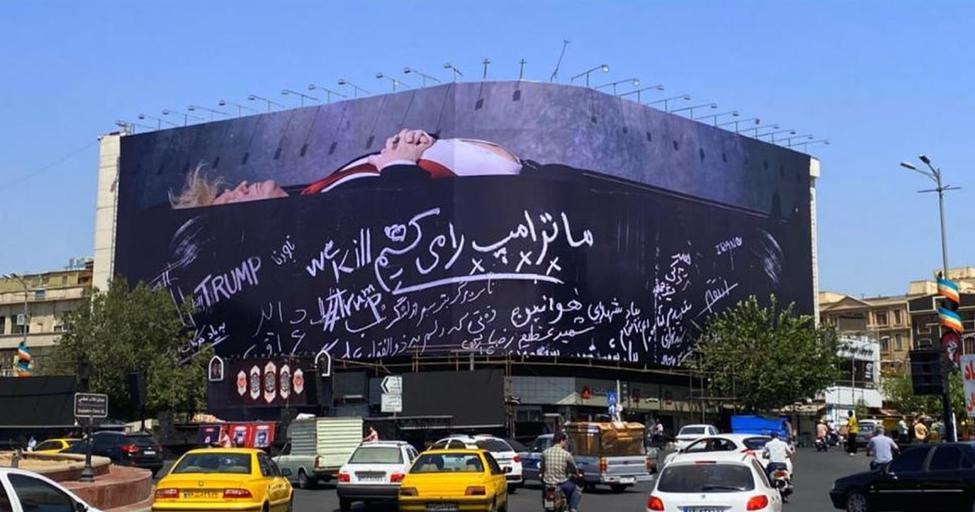
This followed another installation on the Bank Mellat building at the northwestern corner of Enqelab Square, depicting Trump inside a coffin with text in both Persian and English reading: “We will kill Trump.”
As parliament reconvened with lawmakers chanting slogans on the chamber floor, at least two MPs issued direct threats. During a nighttime rally, MP Sattar Hedayatkhah passed his hat through the crowd, explicitly calling on women to donate their gold jewelry to finance Trump’s assassination.
Similarly, Salar Velayatmadar, a member of the National Security and Foreign Policy Committee, spoke of Qisas (retributive justice) against American and Israeli leadership, claiming that the Islamic Republic would target “two tiers of commanders and two tiers of decision-making officials” in both nations. He concluded that following the US Congress’s authorization of military force, “all arguments have ceased, and Iran’s path is clear.”
Threats Borne on the Backs of the Iranian People
Omid Memarian, a political analyst at the DAWN institute in the United States, tells IranWire that there are two distinct camps in Iran regarding the war. The first camp desires negotiations, establishing an agreement, and ending the vicious cycle of “war-ceasefire-war.” The second camp consists of those who profit from the Islamic Republic’s sanctions and conflicts with the region and the United States; backed by extensive media and propaganda machinery, they possess the louder voice.
He explains that this second group is actually pursuing its own interests under the guise of patriotism and national defense: “They claim we are currently in a winning position and hold the upper hand. They argue the Strait of Hormuz should not be reopened, and if it is, tolls must be collected from passing ships, raising issues that present a very serious regional and global challenge.”
Memarian continues: “The United States will fundamentally never accept such an option, and we saw how it responded after just two attacks on commercial ships. Therefore, we are in a situation where the regime, its loyalists, and the groups that have raised this so-called flag of resistance over the past few weeks are driving the narrative. These elements are distinct from genuine patriots who want to protect their soil regardless of the Islamic Republic’s repressive nature. The war faction exploits this pure sentiment for homeland defense to impose its political agenda of continued hostility with the United States and prolong the conflict.”
According to him, “The pro-war faction commands vast resources and propaganda networks, allowing it to impose its will over groups that wish to negotiate despite all the devastation that has occurred.”
The senior political analyst believes that the entire cost of the war falls squarely on the shoulders of the Iranian people. Because the Islamic Republic lacks free elections, it does not worry about how its disastrous decisions will impact its electoral prospects or hold on to power. Consequently, “it can make catastrophic decisions, enter wars, and engage in adventurism while transferring the entire burden onto the public.”
He also points to the desire of this pro-war faction to turn the conflict into a war of attrition, noting that those currently threatening American officials and Trump personally “are unwilling under any circumstances to alter their behavior. If sanctions against Iran were to be lifted, Iranian assets unfrozen, or if Iran were to move toward a more normal relationship with the world, these groups would push back. Those in Iran resisting negotiations and demanding greater aggression to eliminate US officials championing threats of revenge and retaliation are ultimately serving the exact agenda that Israel wants.”
According to Memarian, there are matching factions in Israel: “As JD Vance noted in a recent interview, there are groups in Israel demanding an unlimited war with Iran.”
For the vast majority of the Iranian people, a war of attrition is a horror with no end in sight. It is a nightmare welcomed by hardline warmongers within the Islamic Republic, individuals like extremist MP Amir-Hossein Sabeti, who gleefully characterized Thursday night’s US strikes on southern provinces as a prelude to an American ground invasion while boasting of “high military casualties for the enemy.”…Read more by Jane Doe